
YouTube Declares War on AI Slop: What Mohan's 2026 Crackdown Means for Creators
YouTube CEO Neal Mohan is betting big on transparency and quality control in 2026, wiping out billions of AI-generated views, expanding deepfake detection, and redrawing the line between tool-assisted creativity and machine-made junk. Here's what it means for the platform.
On this page
TL;DR: YouTube CEO Neal Mohan has made fighting AI slop a headline priority for 2026, and the platform is backing the talk with real enforcement. A single January crackdown wiped 4.7 billion views. Deepfake detection now covers politicians and journalists. Creators must disclose synthetic content or risk demonetization. But Mohan isn’t anti-AI. YouTube’s bet is that AI tools should supercharge human creativity, not replace it. The line between those two things is about to define who thrives on the platform and who gets purged from it.
YouTube Declares War on AI Slop: What Mohan’s 2026 Crackdown Means for Creators
Somewhere around mid-2025, a specific kind of video started flooding YouTube’s recommendation engine. You’ve seen them: AI-narrated slideshows about “ancient mysteries,” auto-generated compilations with the same robotic voice swapped over stock footage, music playlists stitched together by generative tools and paired with a single looping image. The term that stuck was “AI slop,” and by January 2026, YouTube’s own CEO was using it publicly.
In his annual letter to creators, Neal Mohan identified managing AI slop as one of YouTube’s four defining priorities for the year. That phrase, “managing AI slop,” landed with unusual bluntness for a platform that typically wraps policy changes in diplomatic language. It signaled that the problem had grown large enough to threaten the thing YouTube cares about most: Watch time driven by content people actually want.
4.7 billion views erased in a single sweep
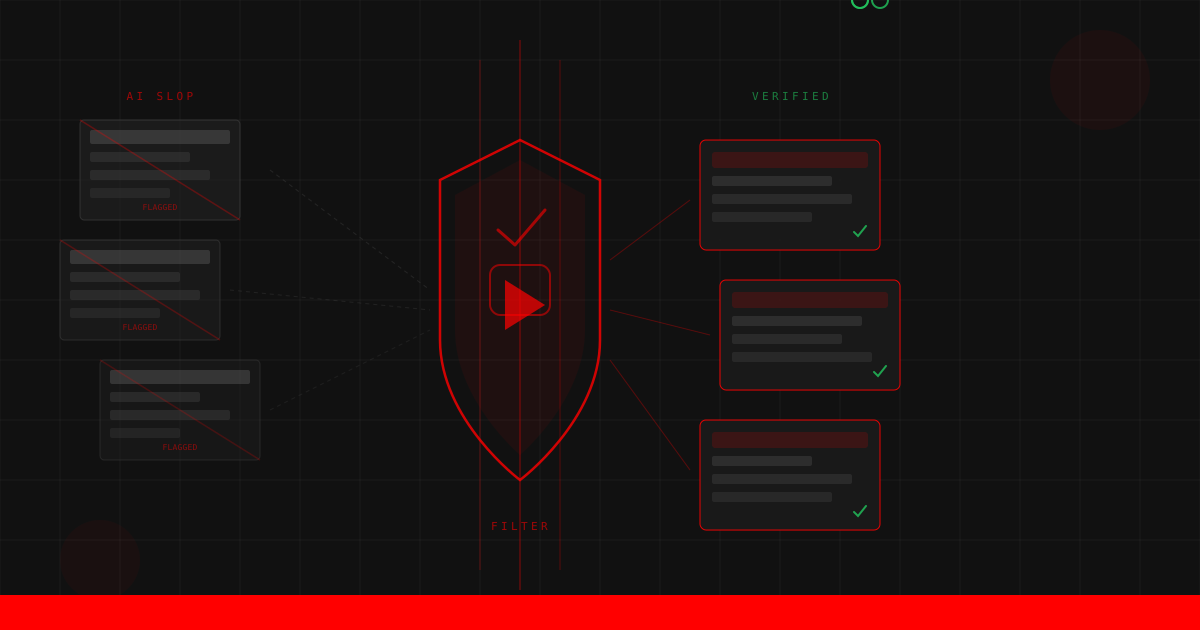
YouTube didn’t ease into enforcement. In January 2026, the platform wiped out 4.7 billion views in a single enforcement wave. Sixteen channels, carrying a combined 35 million subscribers, lost everything. Not a warning. Not a demonetization notice. Gone.
The updated inauthentic content policy now flags anything that looks mass-produced, templated, or machine-made without real human effort at its core. Content caught under this policy loses monetization eligibility entirely. No YouTube Partner Program revenue. No ad splits. No Shorts fund payouts.
What gets flagged specifically? The criteria are more concrete than you might expect:
- AI slideshow videos with no genuine narration or editing effort
- Template clones where only the title or character name changes between uploads
- Auto-generated music playlists paired with static images, often built with tools like Suno
- Faceless compilations that skip commentary, editorial structure, or any sign of human judgment
The common thread: Content where a person pressed “generate” and then pressed “upload,” with nothing meaningful happening in between.
The distinction that matters: Augmentation vs. replacement
Here’s where Mohan’s position gets interesting, and where the nuance sits that most coverage has missed. YouTube isn’t anti-AI. Not even close.
Over one million channels were using YouTube’s own AI creation tools daily by December 2025. The Ask feature, which lets viewers query video content directly, had 20 million monthly users. Six million daily viewers watched autodubbed content (videos automatically translated and voiced in other languages, averaging sessions over ten minutes long).
Mohan wants more AI on the platform, not less. What he’s drawing a hard boundary around is the question of who’s actually creating. In his framing, AI should function like a power tool, extending what a human creator can do. It should not function like an autonomous factory that happens to have a human’s name on the output.
This distinction is going to define the next chapter of content moderation across every major platform. YouTube is staking out its position early: Use AI to produce your videos faster, translate them into twelve languages, generate thumbnails, brainstorm titles. All fine. Use AI to be the creator while you collect checks? That’s the line.
Deepfake detection expands beyond celebrities
The AI slop crackdown is only half the story. The other half is about protecting people from having their faces, voices, and likenesses hijacked by generative tools.
YouTube’s likeness detection technology (essentially Content ID for faces) launched initially for top creators and celebrities. In March 2026, it expanded to cover politicians, government officials, and journalists. The system scans uploaded content for synthetic representations of enrolled individuals. When it finds a match, the enrolled person gets a notification through a private dashboard and can submit a formal removal request.
There’s a deliberate carve-out: Content that constitutes parody, satire, or political commentary may stay up even if it contains a synthetic likeness. YouTube isn’t trying to kill deepfakes as a creative form. It’s trying to prevent deepfakes from being weaponized, particularly heading into election cycles, where a single convincing fake clip can move polling numbers before anyone gets around to debunking it.
YouTube also publicly backed the NO FAKES Act, a bipartisan federal bill that would regulate the use of AI to create unauthorized recreations of someone’s voice or visual likeness. Supporting legislation is unusual for a platform that typically lobbies against regulation. It tells you how seriously Google views the deepfake threat to YouTube’s credibility.
Mandatory transparency labels
Beyond enforcement and detection, YouTube is building a transparency layer that pushes disclosure responsibility onto creators themselves.
The rules are straightforward: If you’ve produced realistic altered or synthetic content, you must say so. YouTube labels content created by its own AI products automatically. For everything else, the burden falls on the creator. Fail to disclose, and you risk losing monetization, or worse, getting caught by YouTube’s detection systems and facing a policy strike.
This isn’t purely altruistic. YouTube has a business reason to care about transparency. Advertisers don’t want their brands running against unlabeled AI-generated content that viewers later discover is fake. Brand safety has become the single loudest conversation in digital advertising, and platforms that can’t guarantee content authenticity will lose ad dollars to those that can.
For creators, the practical impact is a new checkbox in the upload flow and a label on their content. Minor inconvenience. But it’s establishing a norm: Audiences have a right to know whether what they’re watching was made by a person or a machine. That norm is going to spread beyond YouTube quickly.
The creator economy backdrop
All of this is happening against a creator economy that keeps accelerating. YouTube has paid over $100 billion to creators, artists, and media companies in the past four years. Its U.S. ecosystem alone contributed $55 billion in GDP in 2024 and supported more than 490,000 full-time equivalent jobs.
Globally, 69 million active creators now publish on the platform, up nearly 12 percent from 2024. YouTube Shorts is averaging 200 billion daily views. Over 500,000 creators participate in YouTube Shopping. The connected TV play has made YouTube the number-one streaming platform by watch time in the U.S. for nearly three years running, according to Nielsen.
Mohan’s AI crackdown isn’t happening despite this growth. It’s happening because of it. A $100 billion creator economy only works if viewers trust the content they’re watching. If AI slop erodes that trust, if audiences start assuming every video might be machine-generated garbage, the entire economic model wobbles.
Consider one telling statistic: AI-generated slop reportedly accounted for 21 percent of YouTube Shorts shown to new users. One in five. At that saturation level, you’re not dealing with a fringe problem. You’re dealing with a platform integrity issue that directly threatens retention and advertiser confidence.
What this means for creators and marketers
If you’re a creator building on YouTube, the strategic read here is clear.
The floor has dropped out from under low-effort AI content. Anyone who built a channel around auto-generated videos (and there were thousands) is either already gone or on borrowed time. YouTube’s enforcement isn’t gradual. It’s a switch that flips.
Human effort is now a competitive moat. Ironic as it sounds, the harder something is to automate, the more valuable it becomes on a platform cracking down on automation. Commentary, original research, personal storytelling, live reaction: These formats gain relative advantage when the machine-made stuff gets cleared out.
The smart play is using AI where it reduces friction without replacing judgment. Autodubbing your content into Spanish to reach new audiences? Great. Using AI to generate B-roll suggestions? Smart. Letting ChatGPT write your entire script while Synthesia delivers it? That’s the territory YouTube is actively policing now.
Disclosing AI use voluntarily, even beyond what YouTube requires, can become a differentiator. Audiences are getting savvier. Creators who get ahead of the transparency curve will build more durable relationships with their viewers.
The bigger picture
YouTube’s AI slop crackdown is the most aggressive quality-control measure any major platform has taken against generative AI content so far. TikTok and Instagram have added labels. Meta has disclosure requirements. But nobody else has wiped billions of views in a single sweep or built facial recognition systems specifically to catch AI-generated likenesses.
Whether this approach scales remains the open question. Generative tools get better every month. The line between “AI-assisted” and “AI-generated” will only get blurrier. YouTube is betting it can police that line with a combination of automated detection, creator self-reporting, and aggressive enforcement.
If they’re right, 2026 becomes the year YouTube cements its reputation as the platform where quality still matters, where human creativity sits at the center even as AI reshapes every tool around it.
If they’re wrong, the slop just gets harder to detect.
Either way, Mohan has drawn his line. Every creator, every marketer, and every competitor is now watching to see if he can hold it.