
Google Goes All-In on MCP With Managed Servers Across Cloud and Maps
Google just made every major cloud service agent-ready by launching fully managed MCP servers. Here's what changed, which services are covered, and why it matters for the AI agent infrastructure space.
On this page
TL;DR: Google has rolled out fully managed MCP servers across its cloud platform, turning services from BigQuery to Maps into plug-and-play endpoints for AI agents. No custom integrations required. Starting March 17, 2026, MCP servers activate automatically when you enable a supported Google Cloud service. Security is handled through IAM and a purpose-built firewall called Model Armor. This is Google’s clearest signal yet that it views agent interoperability, not just model performance, as the competitive battleground.
Google Goes All-In on MCP With Managed Servers Across Cloud and Maps
For the past year, building an AI agent that actually does something useful with enterprise tools has meant repetitive integration work. Each API requires custom connectors, custom authentication flows, and ongoing maintenance that scales linearly with the number of tools you want your agent to access.
Google just knocked down that wall.
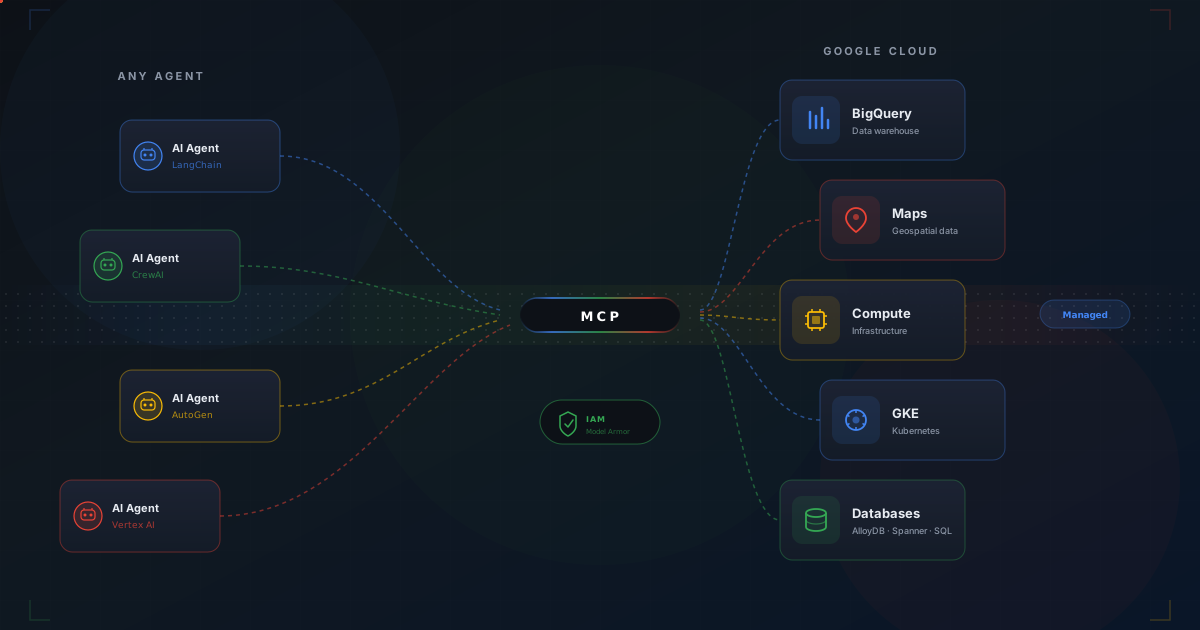
The company announced fully managed, remotely hosted MCP servers spanning its cloud and consumer-facing services. The move transforms Google’s sprawling product portfolio (databases, compute, maps, Kubernetes) into a set of standardised endpoints that any MCP-compatible AI agent can discover and use out of the box.
It’s the largest single-vendor commitment to the Model Context Protocol since Anthropic open-sourced the standard in November 2024. And it changes the economics of agent development significantly.
What Google actually shipped
The initial rollout, which began in December 2025, covered four flagship services:
- BigQuery: Agents can natively interpret schemas, execute queries against enterprise data warehouses, and tap into built-in forecasting features. Data stays in place; it never gets pulled into the model’s context window.
- Google Maps Platform: Branded “Maps Grounding Lite,” this server gives agents access to geospatial data including place information, weather forecasts, routing details, distances, and travel times.
- Google Compute Engine (GCE): Infrastructure capabilities like provisioning and resizing VMs are exposed as discoverable tools, letting agents manage compute workflows autonomously.
- Google Kubernetes Engine (GKE): A structured interface for agents to interact with both GKE-specific and standard Kubernetes APIs.
That alone was notable. But Google didn’t stop there.
In the March 2026 expansion, the company added managed MCP servers for its entire database portfolio: PostgreSQL via AlloyDB, Spanner, Cloud SQL, Firestore, and Bigtable. They also launched a Developer Knowledge MCP server that pipes Google’s developer documentation directly into IDEs, turning reference docs into something agents can query contextually rather than something developers have to search manually.
The roadmap keeps growing. Cloud Run, Cloud Storage, Cloud Resource Manager, Looker, Pub/Sub, Dataplex Universal Catalog, Database Migration Service, Memorystore, and even managed Kafka support are all slated for MCP integration in the coming months.
Why “managed” matters more than “MCP”
The protocol itself isn’t new. MCP has been gaining momentum since Anthropic released it, and by now the official registry lists over 6,400 servers with 97 million monthly SDK downloads across Python and TypeScript. OpenAI, Microsoft, and Amazon have all backed the standard.
What makes Google’s approach different is the word “managed.”
Most MCP servers in the wild are self-hosted. You spin up a container, configure authentication, handle scaling, monitor uptime, and pray nothing breaks when the upstream API changes. For enterprises running agents against production data, that operational overhead is a dealbreaker. It’s the difference between knowing a protocol exists and actually being able to use it at scale.
Google’s managed servers eliminate that entire layer. They run on Google’s infrastructure, inherit Google Cloud’s existing security and governance stack, and activate automatically when you enable the underlying service. After March 17, 2026, there’s no separate setup step. Enable BigQuery, and the MCP server is there.
This is a hosting model, not a protocol innovation. But it’s the hosting model that enterprise buyers have been waiting for.
Security: The part that usually gets bolted on later
Agent security remains the industry’s biggest unresolved question. When an autonomous system can read your databases, modify your infrastructure, and query your analytics platform, the attack surface expands dramatically. Security researchers flagged multiple MCP vulnerabilities in 2025, including prompt injection paths, overly permissive tool combinations that could enable data exfiltration, and lookalike tools that could silently replace legitimate ones.
Google’s response is layered, and worth unpacking because it goes beyond what most MCP implementations offer.
Every MCP tool call runs through Google Cloud IAM. Agents need the roles/mcp.toolUser role plus specific service permissions for whichever tool they’re accessing. The agent doesn’t decide what it’s allowed to do. The infrastructure enforces boundaries that no amount of prompt engineering can override.
On top of that, Google built a dedicated firewall for agentic workloads called Model Armor that sits between the agent and the MCP server. It sanitises tool calls and responses in real time, scanning for prompt injection attempts, sensitive data leakage, and tool poisoning. Think of it as a WAF, but purpose-built for the threat vectors that emerge when an LLM is making API calls on your behalf.
Every tool invocation also gets logged. Administrators can set organisation-wide policies that constrain which agents can access which services, creating governance guardrails that work at the platform level rather than the application level.
This defence-in-depth approach (permissions enforced by infrastructure, content filtered at security chokepoints, activity logged for audit) addresses the criticism that MCP’s security model leans too heavily on trusting the model’s judgment. Google is explicitly not trusting the model. It’s trusting the platform.
The bigger picture: Infrastructure as the agent battleground
Take a step back from the product specifics and something strategic comes into focus. Google isn’t competing on model benchmarks here. It’s competing on plumbing.
The AI agent market has matured past the point where raw model capability is the primary differentiator. What matters now is how easily and safely those models can interact with the systems where enterprise data actually lives. Google, with decades of infrastructure investment across databases, compute, networking, and developer tools, is well positioned to make that interaction smooth if it can standardise the interface.
MCP gives them that standard. Managed hosting gives them the enterprise on-ramp.
Compare this to Amazon’s approach with Bedrock AgentCore, which focuses on orchestration and multi-session memory, or to Composio’s managed MCP servers offering 500+ integrations with SOC 2 certification. Each vendor is finding a different lever to pull in the agent infrastructure stack. Google is pulling the “we already run your data” lever, and it’s a strong one.
For developers, the practical upside is real. An agent built on any MCP-compatible framework (LangChain, CrewAI, AutoGen, or custom implementations) can now connect to Google’s managed servers without writing Google-specific integration code. Build once, connect everywhere. That’s the promise MCP was designed to fulfil, and Google’s managed servers are the closest anyone has come to delivering it at enterprise scale.
What this means for teams building agents
If you’re building AI agents that interact with Google Cloud services, the calculus just changed.
Custom connectors for BigQuery, GCE, or GKE are no longer necessary. The managed MCP server handles schema discovery, authentication, and data governance. Because MCP is an open standard, agent workflows built against Google’s MCP servers can theoretically connect to any other vendor’s MCP servers without architectural changes. Your agent code doesn’t carry Google-specific dependencies.
IAM integration and Model Armor aren’t optional add-ons. They’re baked into the infrastructure. For regulated industries (finance, healthcare, government) this removes a significant compliance hurdle.
There’s also no separate provisioning step and no MCP-specific configuration. Enable the service, grant the role, and the agent can start using it. That’s a meaningful reduction in time-to-first-agent for teams experimenting with agentic workflows.
The road ahead
Google’s commitment to expanding MCP coverage across its portfolio suggests the company views this as foundational infrastructure, not a feature checkbox. The inclusion of services like Pub/Sub and Dataplex signals intent to make event-driven and data-governance workflows agent-accessible, opening the door to agents that don’t just query data but actively participate in data pipelines.
The 2026 MCP roadmap from the protocol’s governance body emphasises transport scalability, agent-to-agent communication, and enterprise governance as key priorities. Google’s managed servers align with every one of those themes. Whether this alignment is coincidental or coordinated, it positions Google as both a contributor to and a beneficiary of MCP’s direction.
For the broader industry, the message is straightforward: The era of custom agent integrations is ending. The vendors that make their services easy to discover, easy to connect, and safe to use by autonomous systems will capture the agent-era equivalent of developer mindshare. Google just made a very large bet that it plans to be one of them.
Sources: Google Cloud Blog, TechCrunch, The New Stack, Google Cloud MCP Documentation, MCP 2026 Roadmap