
How Much Do YouTubers Make? Actual Numbers at Every Level
Actual YouTube creator earnings at every level, from 1,000 subscribers to 1 million+. Ad revenue, sponsorships, memberships, and why subscriber count is a terrible proxy for income.
 Jan Schmitz
|
|
7 min read
Jan Schmitz
|
|
7 min read
On this page
The most common question from aspiring creators: “How much money can I actually make?” The honest answer is complicated, because YouTube income varies more than almost any other profession. Two channels with identical subscriber counts can earn 50x different amounts.
Here’s what creators at every level actually take home, where the money comes from, and how to think about YouTube income without the hype. Run your own estimates with our YouTube Money Calculator.
Subscriber count is a terrible proxy for income
Subscriber count tells you almost nothing about earnings. A 50,000-subscriber finance channel targeting US professionals can earn more per month than a 2 million-subscriber gaming channel with a global teenage audience. Three variables matter far more:
Monthly views. This is the actual input to the ad revenue equation. A channel with 500,000 monthly views and 50,000 subscribers earns more from ads than a channel with 100,000 monthly views and 200,000 subscribers.
Niche. Finance channels earn 10-25x more per view than entertainment channels. The CPM (cost per 1,000 ad impressions) gap between these categories is 90x at the extremes. Full breakdown in our CPM data by niche.
Audience geography. A US viewer generates roughly 10-40x more ad revenue than a viewer in India or Southeast Asia. The US market averages $9.29 CPM across standard video formats. India averages $0.50-$1.50.
With those caveats, here are the numbers at each level.
Earnings at every level
1,000 subscribers (the YPP threshold)
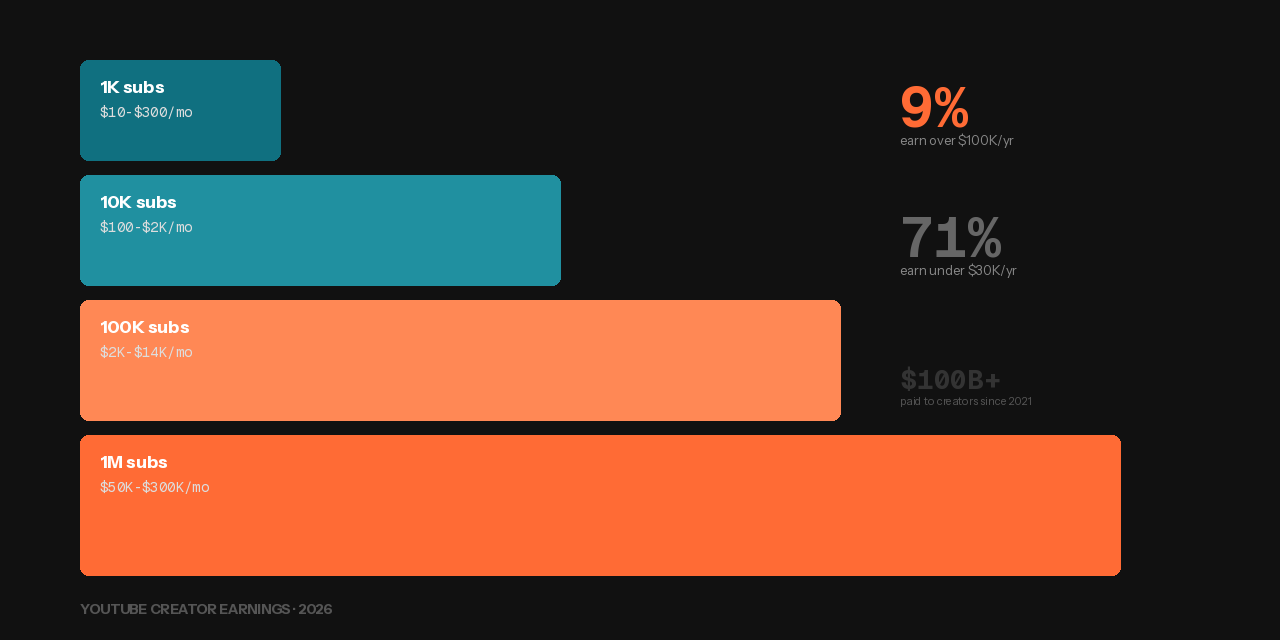
Monthly views: 5,000 to 50,000. Ad revenue: $10 to $300/month.
You’ve just unlocked monetization and the first AdSense checks are arriving. At this stage, ad revenue covers your coffee bill. Don’t quit your job.
The value at 1K subs isn’t the ad money. It’s proof that an audience exists for your content. Sponsors won’t talk to you yet, but affiliate links in descriptions can start generating commission. A tech reviewer placing Amazon affiliate links on product videos can earn $50-$200/month in commissions even at this level, often more than their ad revenue.
10,000 subscribers
Monthly views: 30,000 to 300,000. Ad revenue: $100 to $2,000/month.
Sponsors start reaching out, but the offers at this level are typically free products or $200-$500 per mention. Not exciting, but it adds up if you’re running two per month. Affiliate commissions become a meaningful stream if your content reviews products or recommends tools.
A tech reviewer earning $8 RPM on 200K monthly views takes home about $1,600/month from ads. Not life-changing, but it’s money.
This is also the level where channel memberships start making sense. If 0.5% of your subscribers join at $4.99/month, that’s $250/month before YouTube’s 30% cut. Small, but recurring.
100,000 subscribers
Monthly views: 200,000 to 2 million. Ad revenue: $2,000 to $10,000/month.
This is where YouTube starts to feel like an income source. But sponsorships are the bigger story at this level. Brands pay $3,000-$15,000 per video integration depending on niche and engagement. Two sponsors per month at $5K each plus $4K in ad revenue puts you at $14K/month.
Channel memberships scale with audience size. If 1% of your subscribers join at $4.99/month, that’s $5,000/month gross ($3,500 after YouTube’s 30% cut). Memberships work best for channels with loyal, returning audiences who value exclusive content.
Super Thanks (one-time tips on videos) and Super Chat (live stream donations) add another layer. Mid-size channels report $50-$500/month from Supers, though live-stream-heavy channels skew higher.
1,000,000 subscribers
Monthly views: 2 million to 20 million. Ad revenue: $10,000 to $100,000/month.
Sponsorship deals: $10,000-$70,000 per video. At this level, the highest-earning creators make more from brand deals than from YouTube’s ad system.
The biggest channels monetize through entire businesses that dwarf both ads and sponsorships. MrBeast generates over $500 million/year across his media empire, including Feastables (snack brand), merchandise, and multiple channels. Ryan Kaji pulls roughly $35M/year. CoComelon earns an estimated $128M/year.
But the stat that keeps things honest: only about 9% of independent creators earn over $100,000 per year in total income from YouTube. And only 0.3% of channels ever reach the 100K subscriber mark, which is roughly where part-time viability begins for most niches. The distribution is heavily concentrated at the top.
Revenue streams beyond ads
Ad revenue is usually less than half of total income for serious creators. Here’s the full picture and roughly how much each stream contributes.
Sponsorships and brand deals
The biggest revenue driver above 100K subscribers. Rates scale with audience size and niche:
- Nano-influencers (1K-10K subscribers): $20-$200 per video
- Micro-influencers (10K-100K): $200-$2,000 per video
- Mid-tier creators (100K-1M): $2,000-$10,000 per video
- Large creators (1M+): $10,000-$70,000+ per video
Finance, tech, and business channels command the highest rates because they reach audiences with disposable income. A rough rule of thumb: expect $10-$50 per 1,000 views in sponsorship revenue on top of ad revenue. The range depends on niche, engagement rate, and negotiating ability.
At scale, sponsorships almost always eclipse ad revenue. But they require active work (pitching, negotiating, producing custom segments) and aren’t passive the way ads are.
Channel memberships
YouTube takes 30% off the top. Typical conversion rate: 0.5-2% of subscribers at $4.99/month. A 100K-subscriber channel with 1% conversion nets about $3,500/month after YouTube’s cut.
Memberships work best for channels with a dedicated community that wants exclusive content, early access, or badges. They don’t work well for channels where the audience is casual or transient.
Super Chat and Super Thanks
Creators receive 70% of Super revenue (after local sales tax and App Store fees). YouTube covers the payment processing costs.
Small channels (1K-10K subs): $0-$50/month. Mid-size (10K-100K): $50-$500/month. Top US live streamers report $5,000-$50,000/month.
The outliers are extreme. Tom Grossi, a sports YouTuber, earned $382,125 in Super Chat revenue in February 2025 alone. VTubers and gaming live streamers dominate the Super Chat leaderboards, with Japan and the US as the top markets.
Weekly streamers outperform monthly streamers by a wide margin. The habit-forming nature of a regular live stream schedule is the single biggest factor in Super Chat revenue.
Merchandise
Requires a loyal audience that identifies with the brand. Profit margins are typically 30-50% on apparel. A creator selling 500 shirts/month at $25 with a $10 margin nets $5,000/month.
Merch works best when it’s good on its own, not just a logo on a blank tee. The channels that generate meaningful merch revenue (20-40% of total income in some cases) treat it like a product business, not an afterthought.
Affiliate marketing
Commission rates range from 3% (Amazon Associates) to 50% (digital products, SaaS). Tech reviewers, tutorial creators, and “best of” list channels do well here.
A single well-placed affiliate link in a video description can generate $100-$1,000/month in passive income if the video keeps getting views. The key is evergreen content: a “best budget laptops” video from 6 months ago with an active affiliate link earns while you sleep.
Courses and digital products
The highest margin revenue stream. A $199 course selling 50 copies per month through YouTube traffic = $10,000/month at near-100% margin. Educational and how-to channels are best positioned for this, but any channel with expertise can package it.
YouTube Premium revenue
Same 55/45 split as ad revenue, but distributed based on watch time from Premium subscribers rather than ad impressions. Premium drives up to 30% of revenue on channels whose audience skews toward Premium subscribers (typically older, higher-income, US-based viewers).
If Premium users make up 5% of your views but watch 3x longer than ad-supported viewers, they become about 15% of your watch time and 13-18% of your revenue. It’s a meaningful stream that most creators don’t think about.
The income distribution cliff
YouTube’s income distribution looks more like a cliff than a curve.
71% of independent YouTube creators earn less than $30,000 per year total. That’s all revenue streams combined, not just ads.
Only 9% earn over $100,000.
The average US YouTuber salary works out to about $5,700/month, but that average is pulled up heavily by the top earners. The median is much lower.
YouTube has 69 million active creators across 115 million channels. YouTube paid over $100 billion to creators between 2021 and September 2025, but that money is concentrated among a small fraction of channels.
This isn’t meant to discourage anyone. But it means going in with realistic expectations: treat YouTube like a business from day one. Pick a niche with workable economics. Diversify revenue early. Don’t wait until you’re “big enough” for sponsorships or products.
A 5,000-subscriber education channel selling a $19 ebook earns more from 10 sales per month ($190) than from its entire monthly ad revenue. The creators who build sustainable income start diversifying early, not after hitting some arbitrary milestone.
The platform context
YouTube generated over $60 billion in total revenue in 2025, surpassing Netflix ($45.2B). Ad revenue specifically was $40.4 billion, which exceeds the combined ad revenue of Disney, NBCUniversal, Paramount, and Warner Bros. Discovery.
YouTube’s US GDP contribution exceeded $50 billion in 2024, supporting 490,000 jobs. In the EU, it contributed over 7 billion euros and supported 200,000+ full-time equivalent jobs.
The numbers are big. But the distribution is heavily skewed toward the top, and knowing where you fit matters before you start planning around YouTube income.
Estimate your earnings
The numbers above are ranges. Your specific situation depends on niche, geography, upload frequency, audience retention, and how aggressively you diversify beyond ads. Plug in your actual numbers: YouTube Money Calculator.