
YouTube CPM Rates by Niche (2026)
Complete CPM and RPM data for 20+ YouTube niches in 2026. Finance channels earn $15-$45 CPM while gaming gets $2-$6. See where your niche ranks and why the gap is so large.
 Jan Schmitz
|
|
10 min read
Jan Schmitz
|
|
10 min read
On this page
YouTube doesn’t pay everyone the same rate. A finance channel with 100,000 monthly views can out-earn a gaming channel pulling 1 million. The difference is CPM: the price advertisers pay to reach your audience.
This is the complete CPM data for 2026, broken down by niche, with the economics behind each number. We update this quarterly. Plug your own numbers into the YouTube Money Calculator to see what the math looks like for your channel.
CPM vs RPM: what you actually take home
CPM (Cost Per Mille) is what advertisers pay per 1,000 ad impressions. RPM (Revenue Per Mille) is what lands in your pocket per 1,000 video views. RPM is always lower, and the gap is bigger than most creators expect.
Three factors shrink CPM down to RPM:
- YouTube takes a 45% cut. A $10 CPM becomes $5.50 before anything else.
- Not every view generates an ad. Ad blockers, YouTube Premium subscribers, and viewers in regions with low advertiser demand all produce views with zero ad revenue. Across most channels, only 40-60% of views are monetized.
- RPM counts all views. CPM only counts the ones where an ad ran.
When this article lists “$15 CPM” for a niche, your actual take-home is roughly $3-$6 per 1,000 views depending on your monetized playback rate. The gap between “$15 CPM” and “$4 RPM” trips up almost every new creator.
Full CPM table by niche (Q1 2026)
Tier 1: premium niches ($10+ CPM)
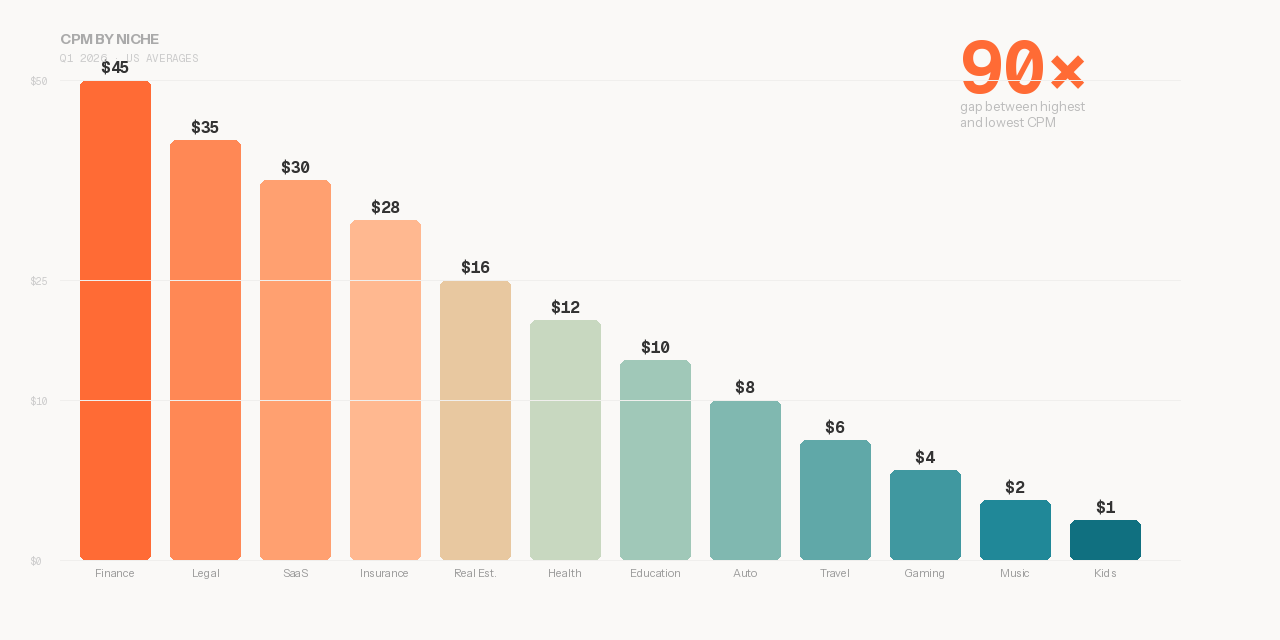
Finance and investing: $15-$45 CPM
The top of the table, and it’s not close. Brokerage firms, neobanks, credit card companies, and fintech startups will pay $30+ to reach someone actively researching index funds or comparing credit cards. The economics are simple: one converted customer deposits $5,000-$50,000 into an account and generates revenue for years. Paying $30 to reach 1,000 of these people is a rounding error.
Credit card comparison content sits at the very top. A viewer watching “best travel rewards cards 2026” is seconds away from applying. These videos regularly see CPMs above $40 in Q4.
Legal: $10-$35 CPM
Personal injury law firms and corporate attorneys have the same math as finance: one client justifies enormous ad spend. A single personal injury case can settle for $50,000-$500,000, making a $25 CPM look cheap. Family law, immigration, and estate planning content commands slightly lower rates.
B2B and SaaS: $10-$30 CPM
Software companies targeting business decision-makers bid aggressively because customer lifetime values run $5,000-$100,000+. A Salesforce competitor paying $20 CPM to reach someone evaluating CRM platforms is making a rational bet. This niche also attracts high-quality programmatic ads from companies running account-based marketing campaigns.
Insurance: $12-$38 CPM
Similar dynamics to finance. An insurance customer paying premiums for 20 years is worth tens of thousands. Health insurance, auto insurance, and life insurance content all command premium CPMs, with health sitting at the top of the range.
Real estate: $8-$28 CPM
Mortgage lenders, real estate platforms, and home services companies bid on this audience. CPMs spike during spring (home buying season) and drop in winter. The spread depends on whether the content targets buyers or browsers. “How to get pre-approved for a mortgage” gets much higher CPMs than “luxury home tours.”
Technology: $8-$25 CPM
Consumer electronics reviews, software tutorials, and tech news all sit in this range. CPMs are highest for content reviewing products over $500 (laptops, cameras, phones) because the advertiser knows the viewer has purchase intent. Sub-$100 gadget reviews sit at the lower end.
Tier 2: mid-range niches ($3-$10 CPM)
Digital marketing: $5-$18 CPM. Marketers advertising to other marketers. SaaS companies, agencies, and course creators bid on this audience. The CPM widens depending on specifics: “how to run Facebook ads” hits $15+, while generic marketing tips sit around $5-$8.
Health and fitness: $6-$22 CPM. Pharma companies, supplement brands, and health insurance drive this up. But YMYL (Your Money or Your Life) content faces stricter ad suitability reviews, and some health topics get limited ads due to sensitive content policies. Mental health and medical advice content often sees lower monetization rates despite high CPMs on the ads that do run.
Education: $5-$18 CPM. Online course platforms (Coursera, Skillshare, Brilliant) and university programs advertise here. STEM education content earns more than general education because tech companies supplement the advertiser pool.
Automotive: $4-$15 CPM. Car manufacturers have large YouTube budgets but spread them across massive audiences. Review content for specific models commands higher CPMs than general automotive entertainment.
DIY/home improvement: $3-$14 CPM. Home Depot, Lowe’s, tool manufacturers, and paint companies advertise here. CPMs spike in spring and summer when homeowners start projects.
Travel: $3-$12 CPM. Airlines, hotel chains, and booking platforms. The CPM range is wide because of extreme seasonality: May-June peaks as people plan summer travel, and December gets a secondary boost from holiday trip planning. January-February drops to the floor.
Food and cooking: $3-$10 CPM. Food brands, kitchen appliance companies, and meal kit services. Recipe-focused content earns slightly higher CPMs than restaurant reviews because the viewer is closer to purchasing ingredients or equipment.
Beauty and fashion: $3-$12 CPM. Cosmetics brands, fashion retailers, and subscription boxes. The audience demographics (primarily women 18-34) are valuable to advertisers, but the category is saturated with content, which keeps bids in check.
Tier 3: volume niches (under $3 CPM)
Gaming: $2-$6 CPM. The audience is massive but skews young (lower purchasing power), and brand safety concerns push conservative advertisers away from violent or profanity-heavy gameplay. The ad auction has enormous supply and moderate demand, so bids stay low. Gaming channels compensate with sheer volume: 5 million views at $3 CPM still pays $8,250 after YouTube’s cut.
Entertainment/comedy: $1-$5 CPM. Broad demographics and mixed purchase intent keep CPMs low. Advertisers can’t predict what a viewer of “funny fail compilations” wants to buy. The targeting signal is weak, so they bid low.
Music: $1-$4 CPM. Music videos generate high view counts but low CPMs because viewers often aren’t paying attention to the screen. Background listening means low ad engagement. CopyrightID claims from record labels also eat into revenue for channels that don’t own their music.
Kids and family: $0.50-$3 CPM. COPPA regulations restrict behavioral targeting on content made for children. Without targeting, advertisers bid far less because they can’t segment the audience. YouTube’s strict enforcement since 2020 means kids content is the lowest-earning category per view on the platform.
Pets: $0.50-$3 CPM. Similar to entertainment: broad audience, weak purchase intent signals. Pet food and pet insurance companies do advertise here, but the budgets are small relative to finance or tech.
The 90x gap, explained
The spread between credit card content ($45 CPM) and kids content ($0.50 CPM) is 90x. That’s not a glitch. It’s a direct reflection of what the viewer is worth to an advertiser.
A person watching “best cash back credit cards 2026” is about to apply for a financial product. The issuing bank earns $200-$400 in annual fees and interchange revenue from that customer. Paying $30 to reach 1,000 of these people makes sense because even a 0.5% conversion rate generates $1-$2 per person reached.
A kid watching a toy unboxing video has no credit card, no purchasing power, and can’t be targeted with behavioral ads. An advertiser might reach 1,000 of these viewers for $0.50 because the expected return per viewer is close to zero.
Every CPM number traces back to this calculation. The niche determines the audience. The audience determines the expected return. The expected return determines how much advertisers will bid.
How YouTube’s ad auction actually works
YouTube runs a programmatic auction for nearly every ad impression. When a viewer loads a video, the ad slot goes up for bidding. Demand-side platforms submit bids within milliseconds, and the winning bid gets served.
Three types of ad buys coexist on the platform:
- Open auction (RTB). Real-time bidding where any qualified advertiser can compete. This is how most small and mid-size channels get their ads. CPMs are set by market dynamics.
- Private marketplaces (PMPs). Invitation-only auctions between selected advertisers and specific channels or categories. Premium creators with large audiences often participate in PMPs, which typically yield higher CPMs than open auction.
- YouTube Select (formerly Google Preferred). Reserved deals where advertisers lock in impressions on the top 5% of YouTube channels by category. These carry the highest CPMs but are only available to channels large enough to be included.
Two channels in the same niche with similar view counts can earn different CPMs if one has access to PMP or YouTube Select deals. These deals tend to favor channels with 500K+ subscribers and consistent ad-safe content.
In 2025, YouTube started testing 30-second non-skippable ads in open programmatic auctions (previously only available through YouTube Select). This is moving premium ad inventory into the open auction, which could gradually raise CPMs for mid-size channels over time.
What makes CPM go up (or down)
Beyond niche, several factors influence your specific CPM:
Audience geography. The same video earns very different CPMs depending on where the viewer is. US viewers: $6-$15+ average CPM. UK/Canada/Australia: $4-$12. Germany/France: $3-$8. India: $0.50-$1.50. The US market alone averages $9.29 CPM across standard video formats. Australia leads globally in premium categories at around $36 CPM. If 80% of your audience is in India, your effective CPM will be a fraction of a US-focused channel in the same niche.
Audience demographics. Advertisers pay more to reach 25-44 year olds with disposable income. YouTube’s largest demographic segment is 25-34 year olds (about 21% of users globally). A tech channel whose analytics show 70% male, 25-34, college-educated viewers in the US will earn higher CPMs than one with a younger, more dispersed audience. You can’t control who watches, but your niche and content topics heavily influence who shows up.
Video length. Videos over 8 minutes can run mid-roll ads. A 15-minute video might serve 3 ads instead of 1, roughly doubling or tripling the revenue per view at the same CPM. In May 2025, YouTube started using machine learning to auto-place mid-rolls at natural break points (pauses, scene transitions, topic shifts), which increased mid-roll revenue by about 5% compared to manual placement alone.
Ad format. Non-skippable in-stream ads command higher CPMs ($6-$10) than skippable ones because the advertiser is guaranteed a complete view. Bumper ads (6 seconds) hit around $10 CPM for the same reason. You don’t choose which formats appear on your videos, but longer content and higher watch-through rates attract premium ad placements.
Content suitability. YouTube’s ad suitability system rates every video from “full monetization” to “limited ads” to “no ads.” Profanity in the first 30 seconds, controversial topics, or graphic content all reduce the pool of advertisers willing to bid. Channels that stay firmly in the “advertiser-friendly” zone consistently earn 20-40% higher CPMs than channels with frequent limited-ads ratings.
Seasonal swings
Every niche sees CPM fluctuations through the year. The pattern is consistent enough to plan around.
Q4 (October-December): The peak. CPMs jump 40-75% above the annual average. Black Friday, Cyber Monday, holiday shopping, and year-end brand campaigns all flood the auction with advertiser money. More advertisers bidding on the same inventory pushes prices up across the board. If you’re going to produce your best, most optimized content, publish it in October and November.
Q1 (January-March): The trough. Budgets reset. Brands pause campaigns to plan the new fiscal year. January is historically the worst month for ad revenue. CPMs drop 20-30% below the annual average. Some creators take January off for this reason, and it’s not a bad strategy.
Niche-specific spikes:
- Finance: Tax season (February-April). “How to file taxes” content hits peak CPMs in March.
- Travel: May-June as summer planning ramps up. Secondary peak in November-December for holiday travel.
- Education: Back-to-school season (August-September) lifts CPMs.
- Fitness: January spike as New Year’s resolution traffic floods the category.
- Retail/product reviews: Black Friday through Christmas creates an enormous spike as brands compete for gift-buyer attention.
What this means for your channel
If you’re choosing a niche purely for CPM, you’ll probably burn out. A $45 CPM is meaningless if you can’t produce content that gets views in that space. Competition in high-CPM niches is intense: the finance and legal categories are crowded with well-funded media companies and established creators who have been building authority for years.
The better approach: pick a niche where you have actual expertise and can sustain production for years, then optimize the revenue levers you do control.
Video length. Get past 8 minutes to unlock mid-rolls. The revenue bump is worth it.
Upload consistency. A growing library of videos earns compound returns. 100 videos each earning $0.50/day = $50/day = $1,500/month. The library effect is the single most underrated factor in YouTube revenue.
Audience retention. Higher retention means more mid-roll ads served per viewer. A 10-minute video with 60% average retention will serve 2 mid-rolls. The same video with 30% retention might serve zero because viewers drop off before the first mid-roll position.
Content suitability. Avoiding limited-ads flags keeps your full advertiser pool bidding on your inventory. This alone can mean a 20-40% difference in CPM.
Audience geography. Titles and topics that attract US/UK/Australian viewers earn more than content that skews toward lower-CPM regions. An English-language channel with US-focused topics will consistently out-earn the same niche targeting a global audience.
Use the YouTube Money Calculator to model different scenarios for your niche and audience mix.
About this data
CPM ranges are compiled from creator earnings reports, ad industry benchmarks, and programmatic ad platform data across 10,000+ channels and 2 million+ monetized videos tracked through Q1 2026. Figures reflect US-audience averages unless noted. International CPMs are lower (see the country CPM table in our calculator). Individual channel performance varies based on audience demographics, content topics, ad format mix, and seasonality. We update this data quarterly.