
YouTube Partner Program Requirements 2026
What you need to join YPP in 2026: subscriber thresholds, watch hours, the Shorts path, the AI content crackdown, inactivity penalties, and what the review team actually checks.
 Jan Schmitz
|
|
8 min read
Jan Schmitz
|
|
8 min read
On this page
You can’t earn ad revenue on YouTube until you’re in the YouTube Partner Program (YPP). The subscriber and watch hour thresholds have been stable since 2023, but 2025 and 2026 brought meaningful changes to enforcement, especially around AI-generated content and channel activity requirements.
Here’s what you need, how the application works, what gets channels rejected, and the new rules you need to know about.
The two tiers
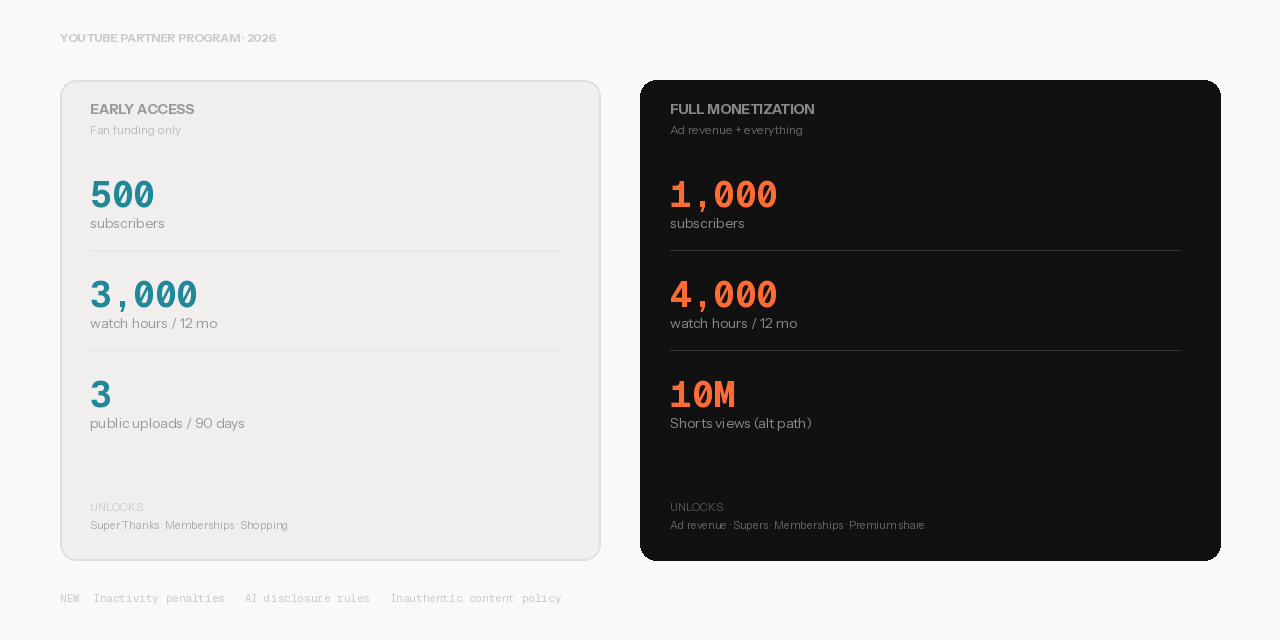
YouTube runs two levels of the Partner Program. The full tier unlocks ad revenue. The early-access tier unlocks fan funding only.
Full monetization (ad revenue)
This is the tier that pays. Requirements:
- 1,000 subscribers
- 4,000 public watch hours in the past 12 months or 10 million public Shorts views in the past 90 days
- No active Community Guidelines strikes
- 2-Step Verification enabled on your Google Account
- A linked AdSense account
- You live in a YPP-eligible country (120+ countries qualify)
The Shorts alternative (10M views in 90 days) has been available since 2023. It’s a real path: Shorts can accumulate views fast enough to hit 10 million in under 3 months if you get a few viral hits. But you still need 1,000 subscribers, which can take longer through Shorts alone than through long-form content. The fastest route combines both formats.
Once approved, you get access to: ad revenue on long-form and Shorts, Super Chat, Super Thanks, Channel Memberships, Shopping features, and YouTube Premium revenue share.
Early-access tier (fan funding only)
The lower tier gives creators some monetization before hitting the full thresholds:
- 500 subscribers
- 3,000 public watch hours in the past 12 months or 3 million public Shorts views in 90 days
- 3 valid public uploads in the past 90 days
This unlocks: Super Thanks (one-time tips on videos), Channel Memberships (monthly subscriptions), and YouTube Shopping (product tagging). It does not unlock ad revenue.
For most creators, the revenue from this tier is small. But memberships can generate recurring income if your audience is engaged enough to pay. Even at 500 subscribers, if 2% join memberships at $4.99/month, that’s $50/month. Not much, but it’s a start while you push toward the full monetization threshold.
The application process
Once you meet the thresholds, there are five steps:
Step 1: Apply in YouTube Studio. Go to Monetization in the left sidebar. If you meet the requirements, the “Start” or “Apply” button appears.
Step 2: Sign the YPP terms. This is a legal agreement covering how you earn revenue and what content policies you agree to follow. Read it.
Step 3: Link AdSense. You need an AdSense account to get paid. If you don’t have one, you create it during this step. If you have one from a blog or another channel, link it.
Step 4: Wait for review. YouTube’s team reviews your channel. They look at your most popular videos, overall channel content, metadata (titles, descriptions, tags), and Community Guidelines compliance. Typical wait: a few days to 4 weeks. Channels with clean records and clearly original content tend to get approved fastest.
Step 5: Get the decision. Approved or rejected. If rejected, YouTube tells you why and you can reapply after 30 days. Second and subsequent rejections require a 90-day wait. Appeals are available within 21 days of any rejection.
What gets channels rejected
Meeting the subscriber and watch hour numbers doesn’t guarantee approval. YouTube’s review team evaluates content quality and policy compliance. The most common rejection reasons, in rough order of frequency:
Reused content
If your channel is mainly compilations of other creators’ clips, stock footage with voiceover, or content repurposed from other platforms without adding original value, expect rejection. YouTube’s documentation specifically flags “content that’s uploaded somewhere else first” as a red flag.
This doesn’t mean you can’t use clips from other sources. Commentary, reaction, educational analysis, and transformative use are all fine. The question is whether your channel adds something that wouldn’t exist without your creative input. A compilation of someone else’s clips with no commentary fails this test. The same clips with your own analysis passes.
AI-generated content (the 2025-2026 crackdown)
This is the biggest enforcement change of the past year. YouTube renamed its “repetitious content” policy to “inauthentic content” on July 15, 2025, and the new name captures the intent more clearly.
The policy targets mass-produced, faceless, AI-driven channels that prioritize output volume over creative value. The pattern YouTube looks for:
- Synthetic voiceovers (TTS) narrating templated scripts
- AI-generated imagery or stock footage with no original footage
- Volume-based upload schedules (5-10 videos/day, all following the same template)
- No identifiable human creator making editorial decisions
YouTube does NOT ban AI tools in content creation. Using AI to help research scripts, generate b-roll ideas, clean up audio, or color-correct footage is fine. The distinction is between AI as a tool (creator uses AI to produce better content) vs. AI as the creator (the channel is a fully automated pipeline with no human creative input).
Violations can result in monetization removal from the entire channel, not just individual videos.
Mandatory AI disclosure (since May 2025)
Separate from the inauthentic content policy, YouTube now requires creators to disclose certain types of AI-generated content. The rules, enforced since May 21, 2025:
Must disclose:
- Face-swapping or digitally replacing one person’s face with another
- Synthetically generating a person’s voice for narration
- Generating realistic depictions of events that didn’t happen (e.g., fake natural disasters, fires)
- Realistic depictions of people saying or doing things they didn’t actually say or do
Does not require disclosure:
- AI used for production assistance (scriptwriting help, idea generation, audio cleanup, color correction)
- Clearly unrealistic content (animation, sci-fi effects, obvious creative uses)
- Content that’s obviously not meant to be mistaken for reality
YouTube may add disclosure labels to your content proactively if you fail to disclose. Videos on sensitive topics (health, news, elections, finance) get a more prominent label directly on the video player. Failure to disclose when required can result in content removal, financial penalties, or YPP suspension.
Misleading metadata
Clickbait titles or thumbnails that don’t match the video content. YouTube calls this “misleading metadata” and it’s one of the most common rejection triggers. A title promising “I made $1 million in 30 days” on a video that’s about something else entirely gets flagged.
Insufficient original content
Short descriptions, generic filler content, and channels where every video follows an identical template with minimal variation. The review team wants to see that someone is making editorial decisions about what to cover and how.
Community Guidelines strikes
Any active strike at the time of review results in automatic rejection. Expired strikes (older than 90 days) don’t count against you, but a history of strikes can delay approval as reviewers look more closely.
Not enough content
Having exactly 1,000 subscribers and 4,000 watch hours but only 5 total videos can raise flags. YouTube wants to see a consistent upload history showing ongoing commitment to the channel, not a burst of activity followed by silence.
Inactivity penalties (new in 2025)
YouTube introduced activity requirements for monetized channels in 2025. Even after YPP approval, you need to keep uploading:
- 30 days without uploads: Automated warning email
- 60 days without uploads: Loss of Super Chat and Memberships features
- 90 days without uploads: YouTube can suspend monetization entirely. You’d need to reapply to YPP
This is a change from previous years when monetized channels could go dormant indefinitely and continue earning from their back catalog. YouTube now wants active channels in the program. Taking a few weeks off is fine. Taking 3 months off puts your monetization at risk.
The practical implication: if you need a break, schedule a few pre-recorded uploads to maintain activity. Even one upload per month keeps you safely within the window.
How fast can you reach the thresholds?
Timelines vary enormously depending on niche, content quality, and upload frequency. Here are realistic ranges from creator reports:
1,000 subscribers
- Shorts-focused creators: 2-6 months (one viral Short can add hundreds overnight)
- Long-form in a specific niche: 6-18 months
- Long-form in a competitive niche with inconsistent uploads: 12-24 months
4,000 watch hours
This requires roughly 240,000 minutes of watch time in 12 months. To put that in context:
- A channel posting weekly 10-minute videos averaging 2,000 views with 50% retention: About 5,200 minutes/week = 270,000 minutes/year. Just barely clears the threshold.
- A channel posting twice weekly with 5,000 average views: Clears it in 3-4 months.
- A channel posting daily with 1,000 average views: Clears it in about 3 months.
The watch hour threshold is harder for some niches than others. Tutorial and educational content tends to have higher retention (viewers watch longer), making it easier to accumulate watch hours per view. Entertainment and Shorts-heavy channels struggle here because viewer attention spans are shorter.
10 million Shorts views (alternative path)
- A channel posting daily Shorts averaging 50,000 views each: 10M in about 7 months
- One viral Short with 5M views plus steady output: Can hit 10M in 2-3 months
- A channel with occasional 100K+ Shorts but inconsistent posting: 4-8 months
The fastest path for most creators: combine Shorts (for subscriber growth and view counts) with long-form (for watch hours). Don’t pick one format exclusively.
After approval: Setting expectations
First-month revenue: Lower than you think. The excitement of monetization crashes into the reality that 5,000-10,000 monthly views generates $15-$50. Check the YouTube Money Calculator for realistic estimates before you start planning how to spend your YouTube income.
Revenue compounds over time. Growth in views is typically slow for the first few months, then accelerates for channels that post consistently and improve. Month 1 of monetization might earn $30. Month 12 might earn $300. Month 24 might earn $3,000. The library effect of having 100+ videos, each earning small amounts daily, creates compound returns.
Diversify early. Don’t wait until some subscriber milestone to think about other revenue streams. A 5,000-subscriber channel with a $19 ebook earns more from 10 sales per month ($190) than from its entire monthly ad revenue. Affiliate links, memberships, and digital products all become viable well before you reach 100K subscribers.
Countries where YPP is available
YPP is available in 120+ countries. The full list includes the US, UK, Canada, Australia, Germany, France, Japan, South Korea, India, Brazil, Mexico, Spain, Italy, Netherlands, and dozens more. YouTube expands the list periodically. The official eligibility list is maintained in YouTube’s Help Center.
If your country isn’t eligible, you cannot join YPP regardless of meeting the subscriber and watch hour thresholds. Moving to an eligible country or changing your channel’s country setting is the only workaround.
What’s changed in 2025-2026
A quick summary of the recent policy updates that affect YPP applicants and existing members:
- Inauthentic content policy (July 2025): Replaces “repetitious content.” Targets mass-produced AI channels.
- AI disclosure requirements (May 2025): Mandatory labels for realistic AI-generated content.
- Inactivity penalties (2025): 90 days without uploads can suspend monetization.
- 3-minute Shorts (October 2024): Shorts up to 3 minutes now eligible for revenue sharing.
- ML-based mid-roll placement (May 2025): YouTube auto-detects natural break points for mid-roll ads, increasing revenue by ~5%.
- Improved Shorts monetization (ongoing): Shorts RPM up roughly 40% year-over-year as YouTube increases ad density in the Shorts feed.
Estimate your future earnings
How much will you actually earn after getting into the program? That depends on niche, audience geography, and monthly view count. Plug in your numbers: YouTube Money Calculator.