
YouTube's Reimagine Lets Anyone Turn a Short Into an AI Video
YouTube just launched Reimagine, an AI-powered remix tool that uses Veo and Gemini to transform any Short into an entirely new video. Here's how it works, why creators are split, and what the opt-out catch means for the future of short-form content.
 Jan Schmitz
|
|
10 min read
Jan Schmitz
|
|
10 min read
On this page
TL;DR: YouTube launched Reimagine on March 18, 2026, an AI remix tool powered by Google’s Veo and Gemini that lets anyone transform a single frame from an existing Short into a brand-new 8-second video. Users can insert themselves using reference photos and custom prompts. Every generated clip links back to the original. The problem? Creators who want to block AI remixes must also kill traditional remixes entirely. With 2 billion monthly Shorts users and 200 billion daily views at stake, Reimagine is YouTube’s biggest bet yet on AI-assisted creation, and its most controversial.
YouTube’s Reimagine Lets Anyone Turn a Short Into an AI Video
On March 18, 2026, YouTube did something that would have sounded absurd three years ago. The platform gave its 2 billion monthly Shorts users a button that takes someone else’s video, extracts a single frame, and uses generative AI to build an entirely new clip from it.
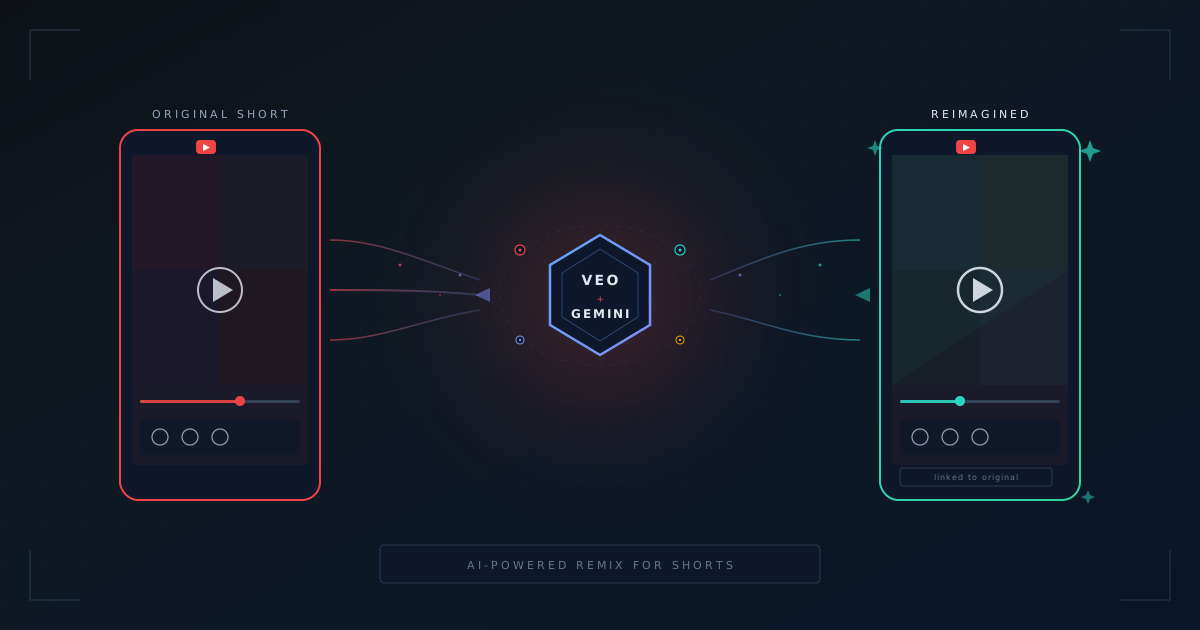
The feature is called Reimagine, and it lives inside the existing Remix menu on eligible Shorts. Powered by Google’s Veo video generation model and steered by Gemini’s prompt engine, it transforms a still frame into an 8-second AI-generated video, complete with audio, motion, and whatever creative direction the user feeds it through text prompts and reference photos.
No other major social platform has shipped anything this aggressive with generative AI. And the gap between “creative revolution” and “intellectual property nightmare” comes down to a handful of design choices YouTube has already locked in.
How Reimagine actually works
The mechanics are straightforward, which is partly what makes the tool so potent.
Browse any eligible Short. Tap the Remix button. Select “Reimagine.” You’ll land on a screen showing a single frozen frame from the original video. From here, two paths.
Path one: Accept the prompts Gemini suggests. The AI reads the selected frame and offers several creative directions: Stylistic transformations, scene extensions, tonal shifts. Pick one, and Veo generates the clip.
Path two: Write your own prompt. Describe what you want. You can also upload up to two reference photos from your phone’s gallery (your face, an object, a pet, whatever). Veo takes the frame, your prompt, your references, and spits out an 8-second video with synchronized audio.
The result gets posted as a new Short on your channel with a link back to the original. That’s the full attribution mechanism: A hyperlink.
YouTube also introduced a companion feature called “Add an Object” during the same testing window. This one is narrower. It lets users insert items into an existing Short’s scene using prompts, without regenerating the entire video. Both features emerged from a limited test that started in late February 2026 with a small group of English-language creators before the broader rollout on March 18.
The engine under the hood: Veo 3.1 and Gemini
Reimagine isn’t running on some experimental side project. It sits on top of Google DeepMind’s Veo, the same video generation model that recently got a major upgrade to version 3.1.
The specs matter here. Veo 3.1 introduced 4K resolution output (3840x2160), making it the first mainstream AI video model to generate at that fidelity. It supports native 9:16 vertical generation, built in no small part for exactly this kind of Shorts integration. The model produces richer native audio, holds character identity across scene changes (a persistent weakness in earlier AI video tools), and accepts up to four reference images per generation.
The 8-second clip limit matters because Veo 3.1’s “Scene extension” feature can chain clips into videos lasting a minute or more, each new segment building from the final second of the previous one. YouTube is clearly throttling the output length for now. The underlying technology could handle far more.
Gemini’s role is less visible but just as important. It runs the prompt suggestion layer, reading the visual content of the source frame and generating contextually relevant creative directions. For users who don’t want to write their own prompts (which, if TikTok engagement patterns are any guide, will be most of them), Gemini is effectively the creative director.
The opt-out problem nobody’s talking about enough
Creators can block their Shorts from being Reimagined. YouTube confirmed this during the testing phase, and it’s framed as a straightforward control: Turn it off, and nobody can use AI to remix your content.
But there’s a catch that changes everything. Opting out of Reimagine also disables all traditional remixes on your content. Every type. The standard “use this sound” remix. The duet-style response format. The green screen remix. All of it, gone.
For creators who built their audience partly through remix culture (and on YouTube Shorts, that’s a huge share of the active creator base), this is a poisoned choice. Accept that anyone with a phone can feed your work into a generative AI model and produce derivative content, or shut down one of the platform’s core discoverability mechanics entirely.
YouTube hasn’t explained why the toggle is all-or-nothing. The technical barrier seems low. Remix type is already categorized internally. Splitting AI-powered remixes from traditional ones would be a product decision, not an engineering challenge. The silence on this point tells its own story. Separating the toggles would almost certainly lead to mass AI-remix opt-outs, and YouTube doesn’t want the feature launching to a half-empty playing field.
What attribution actually means (and doesn’t)
YouTube’s answer to the ownership question is a backlink. Every Reimagined Short displays a connection to the original video. Tap it, and you land on the source creator’s content.
On paper, this sounds fair enough. The original creator gets credit. Their reach could expand as Reimagined videos push traffic backward.
In practice, attribution via hyperlink has never been enough. Think about how image embedding works on the web: A link to the source doesn’t stop the embedding site from capturing the engagement, the ad revenue, and the audience attention. The original creator gets a citation. The derivative creator gets the views.
YouTube’s own data makes the problem concrete. 74% of Shorts views come from non-subscribers. Shorts is a discovery format, not a loyalty format. A viewer who stumbles on a Reimagined clip has zero reason to follow the attribution link back to the original. They’ll watch the AI-generated version, maybe like it, and keep scrolling. The algorithmic benefit flows to the Reimagined clip, not the source material.
This isn’t hypothetical hand-wringing. The remix economy on TikTok and Instagram already shows that derivative content routinely outperforms originals in reach. Reimagine adds generative AI to that equation, making it possible to create derivative content that doesn’t even visually resemble what it came from.
The “AI slop” contradiction
YouTube CEO Neal Mohan put managing AI slop at the top of the platform’s priorities for 2026. In January, YouTube wiped out 4.7 billion views from channels pumping out mass-generated AI content. Sixteen channels with a combined 35 million subscribers lost everything.
Mohan drew a hard line: AI that amplifies human creativity is welcome. AI that replaces it is not. “Just as the synthesizer, Photoshop and CGI revolutionized sound and visuals, AI will be a boon to the creatives who are ready to lean in,” he wrote.
Reimagine lands squarely on that line. Picture two users. One grabs a frame from a cooking Short, adds their own face as a reference, writes a clever prompt that transforms the scene into something unexpected, and posts the result with original commentary. That looks like augmentation. Another bulk-selects frames from trending Shorts, accepts Gemini’s default prompts without touching them, and posts dozens of Reimagined clips per day with zero added creative effort. That looks exactly like the slop YouTube just spent January purging.
The difference between those two users is intent and effort, neither of which scales as a moderation criterion. YouTube will need something more precise than “does this feel creative?” to keep Reimagine from becoming the very content farm it’s simultaneously trying to shut down.
200 billion daily views and a race for creative tooling
Shorts isn’t experimenting from a position of weakness. The format now pulls over 200 billion daily views, up from 70 billion in early 2024. Two billion people use Shorts monthly, ahead of TikTok’s 1.59 billion and Instagram Reels’ 1.8 billion. Engagement rates on Shorts run at 5.91%, leading all short-form platforms. Channels that pair Shorts with long-form content grow 41% faster than those that don’t.
Those numbers explain the strategic logic behind Reimagine. Short-form video is the primary battlefield for attention, and the platforms winning that fight are the ones lowering the barrier to content creation most aggressively. TikTok pioneered this with its sound-based remix system and CapCut integration. Instagram countered with AI-powered editing features and cross-posting tools.
YouTube’s move goes further. Where competitors offer AI-assisted editing, YouTube is offering AI-assisted generation, the ability to conjure something from nearly nothing, using someone else’s work as the seed.
Whether that’s a feature or a threat depends entirely on which side of the Remix button you’re sitting on.
What this means for creators, specifically
If you produce original Shorts: Your content is now raw material. Every frame you publish can be extracted, prompted, and transformed into someone else’s video. Your options: Accept this as a new form of exposure (and hope the attribution links drive meaningful traffic) or disable all remixing on your channel, sacrificing a real discovery channel in the process.
If you’re a remix-native creator: Reimagine massively expands your toolkit. You no longer need to capture footage. A trending Short, a text prompt, and a couple of reference photos become your entire production pipeline. The gap between “viewer” and “creator” just collapsed.
If you’re a brand or marketer: Pay attention. User-generated Reimagined content based on your Shorts campaigns could amplify reach in unpredictable ways, some on-brand, some wildly off. Brand safety frameworks for Shorts will need to account for AI-generated derivatives that bear no visual resemblance to the original content.
If you’re a music artist or label: Shorts already drives substantial music discovery. Reimagined clips that use your audio in AI-generated visual contexts raise novel licensing questions that current agreements almost certainly don’t cover. If someone Reimagines a Short featuring your track into something completely different visually, who controls what?
Where the guardrails stand, and where they’re missing
YouTube has confirmed a few safety measures. Generated clips get the platform’s standard AI-generated content label. The attribution link to the original Short is mandatory. Output is capped at 8 seconds for now.
What’s absent matters more:
- No granular opt-out. AI remixes and traditional remixes share a single toggle.
- No approval workflow. Creators can’t review or approve Reimagined content before it goes live.
- No revenue sharing. Attribution is a link, not a royalty. Original creators earn nothing from Reimagined clips.
- No likeness protection specific to Reimagine. YouTube’s broader likeness detection tools exist, but how they integrate with Reimagine’s reference photo upload remains unclear.
- No volume limits. Nothing publicly prevents a user from Reimagining hundreds of Shorts daily.
Every one of these gaps will create friction as the feature scales. Whether YouTube patches them proactively or waits for a crisis is an open question, and YouTube’s track record heavily favors the latter.
Generative AI as a platform primitive
Reimagine isn’t a standalone experiment. It signals that YouTube is wiring generative AI into the foundation of content creation. Over one million channels were already using YouTube’s AI tools daily by December 2025. Creators will soon generate Shorts using their own AI likeness. AI-powered game creation from text prompts is in the pipeline.
The direction is clear: YouTube wants generative AI to sit alongside the camera roll as a default creation tool. Not a novelty. Not a lab experiment. A baseline capability that shapes how every piece of content gets made.
For a platform serving 2 billion monthly Shorts users and processing 200 billion daily views, the scale implications are hard to overstate. If even a small fraction of that audience starts producing Reimagined content regularly, the volume of AI-generated video on YouTube could dwarf every other source combined within months.
What to watch next
Reimagine is rolling out now. The initial test with English-language creators ran through late February and early March. The March 18 launch date suggests YouTube is satisfied with the technical performance and has accepted whatever creator pushback follows.
A few things worth tracking in the coming weeks:
Opt-out rates. If enough popular creators disable remixing entirely, it’ll pressure YouTube to split the toggle. This is the most likely near-term policy shift.
Content volume. How many Reimagined Shorts get created daily, and what share of them are low-effort bulk jobs? That data will determine whether YouTube needs rate limits.
Creator coalition response. Groups like the Creator Economy Coalition have been vocal about AI-related creator rights. Reimagine hands them a concrete, specific target.
Competitor moves. TikTok and Instagram will be watching adoption closely. If Reimagine drives real engagement numbers, expect copycat features within a quarter or two.
Neal Mohan closed his 2026 letter with a line that now reads as both mission statement and warning: “As we enter 2026, the lines between creativity and technology are blurring, sparking a new era of innovation.”
With Reimagine, YouTube isn’t just blurring that line. It’s handing every user an eraser.
Sources: YouTube Official Blog, 9to5Google, Android Central, Phandroid, DemandSage, YouTube CEO 2026 Letter, Google DeepMind Veo