
YouTube Shorts Hits 200 Billion Daily Views — What It Means for Creators and Brands
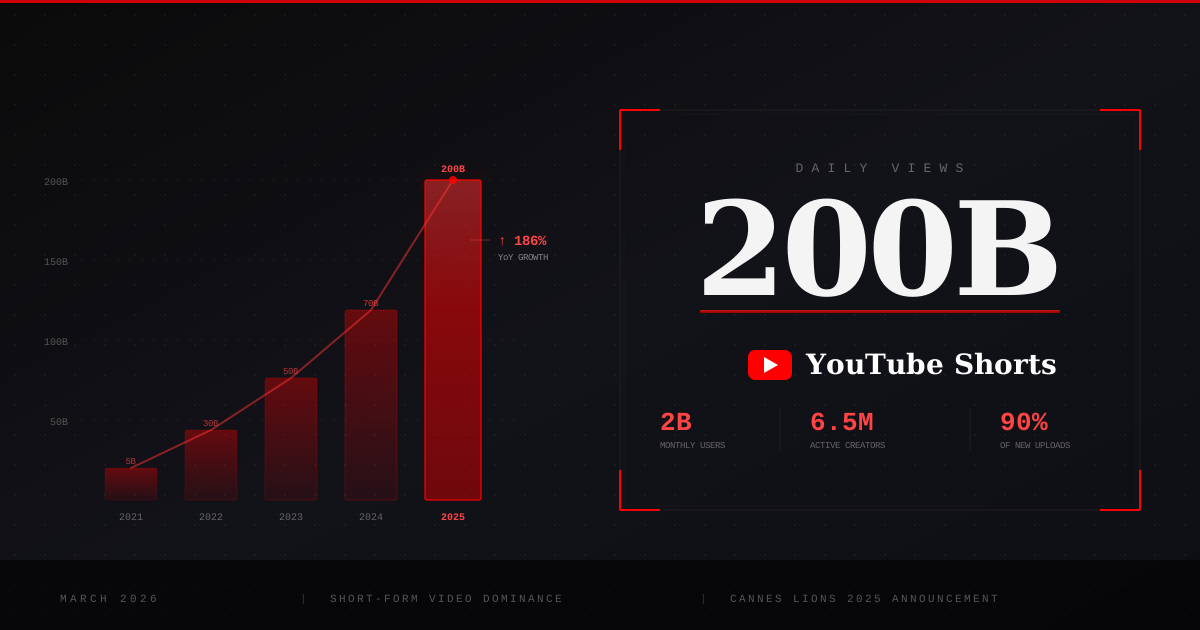
YouTube Shorts has tripled its daily views to 200 billion in just one year. Here's what's driving the surge, how it reshapes the short-form video landscape, and why creators and marketers need to pay attention right now.
 Jan Schmitz
|
|
10 min read
Jan Schmitz
|
|
10 min read
On this page
TL;DR: YouTube Shorts has gone from competitive afterthought to the most-watched short-form video format on the planet. With 200 billion daily views — up 186% from 70 billion just a year earlier — it now outpaces TikTok and Instagram Reels on raw reach. CEO Neal Mohan dropped the number at Cannes Lions alongside the announcement that Google’s Veo 3 AI video tool is coming to Shorts this summer. For creators and brands, the takeaway is blunt: Shorts is no longer YouTube’s side project. It’s the front door.
YouTube Shorts Hits 200 Billion Daily Views — What It Means for Creators and Brands
A number that large deserves a moment to land. Two hundred billion. That’s roughly 25 views for every human being on Earth, every single day, generated by vertical videos that max out at three minutes.
When YouTube CEO Neal Mohan walked onto the Cannes Lions stage in June 2025 — the platform’s 20th anniversary, no less — this was his opening salvo. Not revenue figures. Not subscriber milestones. The Shorts number. And for good reason: it tells a story about where attention lives now, and where it’s heading next.
From 70 billion to 200 billion in twelve months
The growth curve here is genuinely unusual. In early 2024, YouTube reported Shorts was averaging 70 billion daily views. By June 2025, that number had nearly tripled. A 186% year-over-year increase for a product that launched in 2021 and spent its first two years being treated as YouTube’s answer to a question nobody was sure the platform needed to ask.
What changed? Several things, working in parallel.
The algorithm got sharper. YouTube rebuilt its recommendation engine around Shorts in late 2024, prioritizing watch-through rates and subscriber conversion over raw clicks. The result: viewers who started in the Shorts feed stayed longer and explored more. Seventy-four percent of Shorts views now come from non-subscribers, making it the platform’s primary discovery mechanism. If your channel isn’t producing Shorts, you’re functionally invisible to the majority of new eyeballs on YouTube.
The format also expanded. YouTube pushed the maximum Shorts length from 60 seconds to three minutes in October 2024 — a move that immediately opened the door for tutorials, cooking walkthroughs, mini-vlogs, and other formats that felt cramped at one minute. Creators who had been splitting content awkwardly between Shorts and long-form suddenly had room to breathe.
And then there’s a factor that gets less attention than it should: YouTube’s connected TV dominance is feeding back into Shorts. The platform now accounts for 12.5% of total TV viewership in the United States according to Nielsen, surpassing Netflix, Disney+, and Prime Video. When people watch YouTube on their televisions, the algorithm learns what they like. That data improves Shorts recommendations on their phones the next morning. It’s a feedback loop that neither TikTok nor Instagram can replicate, because neither has a meaningful living room presence.
The competitive picture has shifted
For the past four years, the short-form video conversation has been dominated by one question: Can anyone catch TikTok? The answer, it turns out, is that YouTube wasn’t trying to catch TikTok. It was building something different.
TikTok still leads on certain engagement metrics. An average TikTok video generates around 54 comments, compared to roughly 20 on a comparable Short. TikTok’s algorithm remains unmatched at surfacing unknown creators to massive audiences overnight. And its Creator Rewards Program pays more per qualified view — between $0.50 and $1.00 per thousand views, compared to YouTube’s $0.03 to $0.10 range for Shorts.
But reach and retention tell a different story. YouTube Shorts now claims 2 billion monthly users, ahead of Instagram Reels at 1.8 billion and TikTok at 1.59 billion. More to the point, Shorts exists inside the YouTube ecosystem. A viewer who discovers a creator through a 45-second Short can, in the same session, watch a 40-minute deep dive on the same channel, subscribe, turn on notifications, and start watching on their TV that evening. No platform switch required.
That’s the structural advantage Mohan keeps hammering. “Shorts is a gateway,” as one EMARKETER analyst noted, “not a destination.” Channels that combine Shorts with long-form content grow 41% faster than those using only one format. TikTok can’t offer that pipeline because TikTok doesn’t have a long-form ecosystem. Instagram can’t either — Reels lives alongside photos and Stories, not next to hour-long documentaries.
The TikTok ban uncertainty in the United States throughout 2024 and early 2025 also pushed creators to diversify. Many who had built their entire audience on TikTok began cross-posting to Shorts as insurance. Some found that their Shorts actually outperformed their TikToks, particularly mid-sized creators in the 100K to 1M subscriber range where YouTube’s algorithm seems to be most generous.
What 200 billion views means for the ad market
Now for the money, because that’s ultimately what turns a vanity metric into a strategic shift.
YouTube doesn’t break out Shorts ad revenue separately, but the signals are clear. The company has steadily increased the ad load in the Shorts feed throughout 2025, inserting more ads between videos without (apparently) driving users away. That increased inventory, combined with the surge in views, means the total ad pool available to creators has grown substantially. Creators report that Shorts RPM — revenue per thousand views — has climbed 15 to 25 percent compared to 2024 levels.
The monetization model itself remains distinct from long-form YouTube. Rather than serving pre-roll or mid-roll ads on individual Shorts, YouTube pools all Shorts feed ad revenue and distributes it based on each creator’s share of total engaged views. Monetizing creators keep 45% of their allocated share. If a Short uses licensed music, the music rights holders take their cut first, which can reduce the creator’s payout by half or more.
Is this generous? Compared to what TikTok pays smaller creators (often nothing at all until they hit specific thresholds), it’s more accessible. Compared to long-form YouTube revenue shares, it’s noticeably thinner. A creator earning $5 to $8 RPM on long-form videos might see $0.04 to $0.07 RPM on Shorts. The math only works at serious scale.
But that’s precisely where 200 billion daily views changes the equation. When the total view pool is that enormous, even a tiny RPM adds up. And YouTube has been stacking additional revenue channels on top of Shorts: product tagging, affiliate links, fan-funded features like Super Thanks, and the expanding YouTube Shopping integration that lets creators sell products directly from their Shorts.
For brands and advertisers, the 200 billion number reframes Shorts as a media buy, not just a social experiment. Shorts ads now offer reach comparable to prime-time television, with targeting precision that TV can’t match. Expect significant budget reallocation from traditional video buys into Shorts-specific campaigns throughout 2026.
Veo 3 and the AI production arms race
Mohan didn’t travel to Cannes just to share a big number. He came with a product announcement: Google DeepMind’s Veo 3 is coming to YouTube Shorts this summer.
Veo 3 is Google’s latest video generation model, and integrating it into Shorts through Dream Screen means creators will be able to generate AI backgrounds, transitions, and video clips directly inside the Shorts creation tools. Think of it as Canva for video, except the engine under the hood is one of the most capable generative AI models on the market.
This matters because production quality has become a real barrier in the Shorts ecosystem. As the format matures, the bar keeps rising. Creators who were thriving with simple talking-head videos two years ago now compete against cinematic edits, custom animations, and professional-grade effects. Veo 3 could flatten that gap by giving solo creators production capabilities that used to require a team and a budget.
But there’s a tension here that YouTube hasn’t fully resolved. Mohan addressed “AI slop” — the flood of low-quality, AI-generated content clogging every platform — and promised better labeling, stronger recommendation signals favoring human creativity, and expanded Content ID protections for creator likenesses. Whether those safeguards can keep pace with the tools YouTube is simultaneously handing out is an open question. You can’t hand someone a firehose and then ask them to be careful with water.
The auto-dubbing feature offers a less contentious example of AI pulling its weight. YouTube has already processed 20 million videos through its automatic translation system, which currently supports nine languages with eleven more coming soon. For Shorts creators, this means a video filmed in Portuguese can reach audiences in Japan, Germany, and Nigeria without the creator lifting a finger beyond hitting publish. Language barriers that once required dedicated localization teams are collapsing in real time.
The 90% upload stat nobody’s talking about
Here’s a number buried in the data that deserves more scrutiny: over 90% of all new YouTube uploads are now Shorts. The platform reached 29 billion total videos in late 2025, and the vast majority of that growth came from short-form content. More than 6.5 million creators upload at least one Short every month.
This cuts both ways. The opportunity is obvious — there has never been more content flowing through the Shorts ecosystem, which means more entry points for audiences and more chances for discovery. The flip side is equally obvious: the feed is getting crowded. Standing out in a pool of 200 billion daily views requires either exceptional content, exceptional consistency, or both.
Shorts now accounts for roughly 10% of total YouTube watch time in the United States. That might sound modest until you consider the context. YouTube users in the U.S. watch approximately 1 billion hours of content on TV screens alone every day. Ten percent of that total pie, grabbed in less than three years of serious scaling, is a land grab that would make any TV network jealous.
The demographic picture matters here, too. YouTube Shorts’ largest audience segment skews 18 to 34, but the platform’s user base runs much broader than TikTok’s. YouTube reaches people across every age group, income bracket, and geography. That breadth makes Shorts attractive to advertisers who need scale beyond the Gen Z bubble.
What creators and marketers should actually do
Enough analysis. If you’re running a channel or managing a brand’s video strategy, here’s what the 200 billion milestone means in practice.
Treat Shorts as your discovery engine
If your channel isn’t producing Shorts regularly, you’re leaving discoverability on the table. Seventy-four percent of Shorts views come from non-subscribers. That’s not a nice-to-have — it’s the primary way new audiences find creators on YouTube in 2026. Aim for a minimum of three to five Shorts per week, treating them as trailers for your deeper content.
Build the Shorts-to-long-form pipeline
The channels growing fastest are the ones using Shorts to hook viewers and long-form content to keep them. A compelling 60-second Short that addresses a question, then points viewers to a 15-minute explainer, is the most efficient growth loop on the platform right now. YouTube’s algorithm actively rewards this behavior — it reads the Shorts-to-long-form click as a strong engagement signal.
Stack your monetization
Shorts ad revenue alone won’t pay the bills for most creators. But Shorts combined with affiliate links, product tags, Super Thanks, and channel memberships start to compound. YouTube Shopping, in particular, is expanding fast. Creators who tag products in their Shorts are seeing conversion rates that beat traditional social commerce because the purchase happens without leaving the YouTube app.
Get ahead of the AI production wave
Veo 3 and tools like it will raise the production floor for everyone. Start experimenting with AI-assisted editing now, whether through YouTube’s native tools or third-party options. The creators who figure out how to blend AI capabilities with genuine personality and expertise will pull ahead of those who either ignore the tools or lean on them so heavily that their content becomes indistinguishable from the algorithmic noise.
Think globally from day one
Auto-dubbing rewrites the math on international audiences. If you’re creating content in English and ignoring the fact that YouTube can now automatically translate your Shorts into 20 languages, you’re walking past an enormous audience. Creators who optimize for global reach — through universal visuals, clear speech patterns, and culturally adaptable content — will capture an outsized share of that 200 billion views pool.
The bigger picture: Short-form video is the internet now
Zoom out from the YouTube-specific numbers and the broader trend is almost uncomfortably clear. Short-form video isn’t a content format anymore. It’s the default interface for how billions of people consume information, entertainment, and commerce online.
The short-form video market is projected to grow at a 12.7% CAGR through 2035. Video is expected to account for 82% of all internet traffic by the end of this year. The creator economy underpinning all of this has swelled past $200 billion globally, with Goldman Sachs projections pushing toward $480 billion by 2027.
YouTube’s 200 billion daily Shorts views is the hardest proof point we have that this isn’t a phase. The world’s largest video platform, owned by the world’s largest advertising company, has reorganized its product roadmap around vertical videos that last less than three minutes. That tells you where the attention is, where the money is going, and what the next five years of digital media will look like.
The question for creators and brands isn’t whether to take short-form seriously. That debate ended somewhere around the 100 billion daily views mark. The question now is whether you’re building for a world where Shorts is the primary surface — for discovery, for commerce, for audience relationships — or still treating it as a supplement to your “real” content.
YouTube has placed its bet. Two hundred billion daily views suggest the audience has placed theirs, too.