
YouTube Shorts vs Long-form: Which Pays More in 2026?
Shorts RPM is $0.03-$0.08. Long-form RPM is $2-$15. The per-view gap is 30-100x, but Shorts get far more views. Here's the revenue math for both formats and when to use each.
 Jan Schmitz
|
|
6 min read
Jan Schmitz
|
|
6 min read
On this page
Long-form pays 30-100x more per view. But that number alone doesn’t capture the full picture, because Shorts reach millions of people who would never find your channel otherwise.
Here’s the actual revenue math for both formats and how to think about the tradeoff.
The per-view numbers, side by side
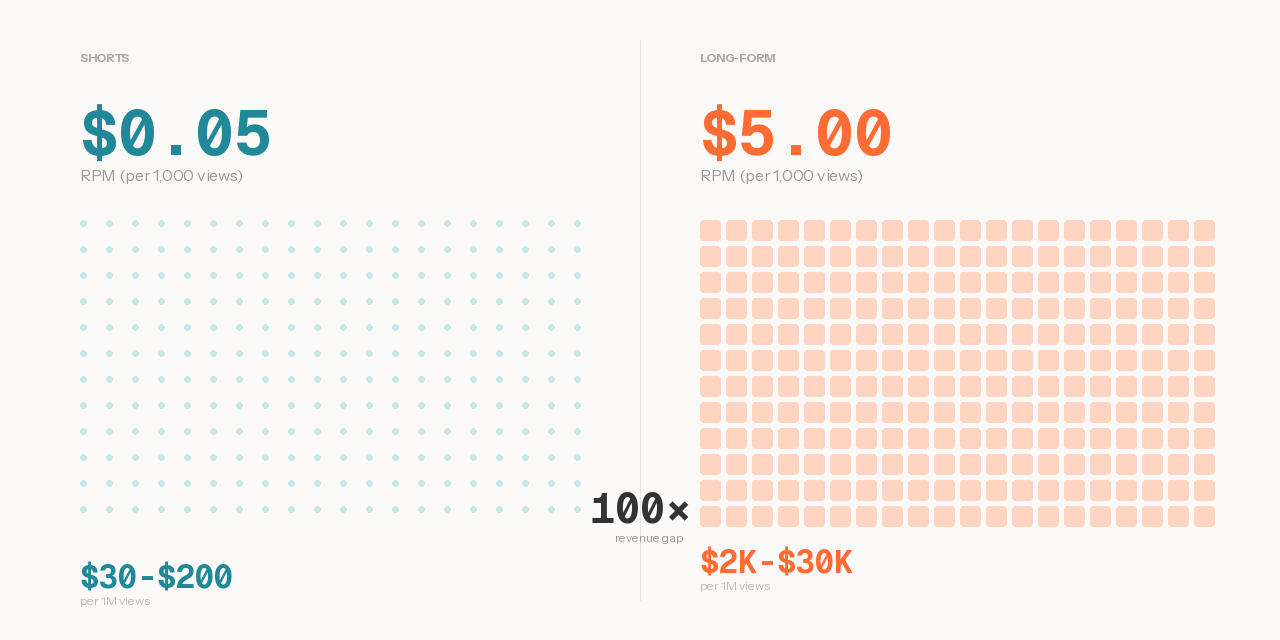
Long-form videos (8+ minutes) earn $2-$15 RPM in the US depending on niche. That means every 1,000 views puts $2 to $15 in your pocket after YouTube’s 45% cut. A 10-minute finance video with 500,000 views might earn $5,000-$7,500.
YouTube Shorts earn $0.03-$0.08 RPM for US audiences. Per 1,000 views, that’s 3 to 8 cents. A Short that goes viral with 5 million views might earn $150-$400.
At the 1 million view mark, the comparison is painful:
- Long-form: $2,000 to $30,000 (depending on niche)
- Shorts: $30 to $200
The gap is 30x at the low end and 100x at the high end. Six creators who typically focus on long-form told Digiday their Shorts RPMs were consistently below $0.20, compared to $3-$6 RPM on their regular videos.
International audiences see even lower Shorts RPMs. UK/Canada/Australia: $0.02-$0.06 per thousand views. India and Southeast Asia: $0.003-$0.015.
Why the gap exists
The gap isn’t arbitrary. It comes from three structural differences in how the money flows.
Different ad models
Long-form videos run pre-roll, mid-roll (on 8+ minute videos), and post-roll ads directly on the video. A single viewer might see 2-3 ads during a 15-minute video, each one generating CPM revenue attributed to that specific video.
Shorts work completely differently. No ads run on individual Shorts. Instead, ads appear between Shorts as viewers scroll through the feed. All the ad revenue from those interstitial ads gets pooled together. That pool is then divided among every monetizing creator based on their share of total Shorts views in each country.
This pooling mechanism means your individual Short’s performance doesn’t determine your CPM. You get a slice of a giant pie, and the size of your slice depends on what fraction of total Shorts views you captured. A finance Short and a cat video Short both draw from the same pool. The finance creator can’t benefit from higher advertiser bids the way they can on long-form.
Different revenue splits
On long-form content, creators keep 55% and YouTube takes 45%. On Shorts, the split is reversed: creators get 45%, YouTube keeps 55%. That extra 10 percentage points covers the operational costs of the Shorts feed and the music licensing infrastructure.
A $10 CPM on long-form gives the creator $5.50. The same $10 CPM through the Shorts pool gives the creator $4.50, even before the music licensing deduction.
Different viewer attention
A person watching a 15-minute video is engaged. They’re sitting there, paying attention, not scrolling away after 2 seconds. Advertisers value this attention and bid accordingly.
A person swiping through Shorts at 2-5 seconds per video gives advertisers a fraction of that attention. The ad between two Shorts gets seen for 5 seconds before the viewer taps “skip” or scrolls past. Advertisers pay for the lower engagement with lower bids.
The music licensing math
Shorts has a revenue wrinkle that doesn’t exist on long-form: licensed music. If your Short uses a copyrighted song from YouTube’s audio library, a chunk of your revenue goes to the music publisher before you see anything.
Here’s how the split works:
- No licensed music: 100% of the revenue associated with your Short goes to the Creator Pool. You then get your 45% of that.
- One licensed track: 50% goes to music licensing, 50% goes to the Creator Pool. Your effective share drops roughly in half.
- Two licensed tracks: 67% goes to music licensing, 33% to the Creator Pool. Your share drops by two-thirds.
A Short with a trending song and 1 million views might earn $15-$30 after the music deduction. The same Short with original audio earns $30-$80. If you’re making content where the audio matters (like dance or lip-sync Shorts), the music cut is unavoidable. For talking-head, tutorial, or visual content, original audio or royalty-free tracks preserve your full allocation.
3-minute Shorts (the 2024 expansion)
YouTube expanded the Shorts format in October 2024 to allow videos up to 3 minutes long (previously capped at 60 seconds). Any Short up to 3 minutes uploaded after October 15, 2024 is eligible for revenue sharing.
This changes the calculus for some creators. A 2-minute Short with meaningful content can hold attention longer and potentially contribute more to the Shorts revenue pool than a 15-second clip. But the core economics haven’t changed: it still draws from the same pooled revenue model, and the per-view payout remains far below long-form.
The 3-minute expansion also blurs the line between Shorts and “short long-form.” A 3-minute vertical video uploaded as a Short earns Shorts RPM. A 3-minute horizontal video uploaded as a regular video earns long-form RPM. Same length, very different revenue. Format and orientation determine which monetization path your video takes.
When Shorts make financial sense anyway
The per-view revenue is bad. Shorts still matter financially for three reasons that don’t show up in the RPM numbers.
Subscriber acquisition
Shorts are the fastest subscriber growth engine on the platform in 2026. A single viral Short can add 10,000-50,000 subscribers overnight. Those subscribers then see your long-form content in their home feed, where the real money is.
The Short itself earns $50. The long-form content those new subscribers watch over the next year earns $5,000+. The ROI calculation favors Shorts as an acquisition channel, even at terrible RPMs, as long as you have long-form content to catch those new subscribers.
Bigger numbers for sponsorship negotiations
Brands look at total monthly views and subscriber count when pricing sponsorship deals. A creator with 500K monthly views from Shorts plus 200K from long-form commands higher sponsorship rates than someone with 200K total. The Shorts views inflate the media kit even if they generate negligible ad revenue directly.
At the sponsorship negotiation table, $5 CPM on 700K total views beats $5 CPM on 200K views. Shorts are the fastest way to pump up the total view number.
Testing content ideas
A Short takes 30 minutes to produce. A long-form video takes 10-30 hours between scripting, filming, editing, and thumbnailing. If you aren’t sure whether a topic will resonate, test it as a Short first. The one that performs becomes a long-form video with proven demand.
This saves serious time. A channel that tests 10 Short ideas per week and converts the top 2 into long-form videos will produce better long-form content than a channel guessing which topics to invest 20 hours in.
The hybrid strategy
The creators earning the most in 2026 aren’t choosing between formats. They’re using both for different purposes:
- Publish 3-5 Shorts per week for audience growth and discoverability
- Publish 1-2 long-form videos per week (8+ minutes each) for ad revenue and sponsorships
- Clip long-form content into Shorts to drive viewers back to the full video
- Use original audio on Shorts to avoid the music licensing cut
- Track which Shorts topics drive the most subscriber conversions, not just view counts
The key metric for Shorts isn’t views or RPM. It’s subscriber conversion rate. A Short with 500K views that converts 2,000 new subscribers is worth more than one with 2 million views and 200 subscribers, because those subscribers generate long-form views for months afterward.
Are Shorts RPMs improving?
Yes, slowly. Creators report roughly 40% year-over-year improvement in Shorts monetization as YouTube increases the number of ads in the Shorts feed. The total Shorts revenue pool is growing.
But even a 3x improvement in Shorts RPM would bring it to $0.10-$0.20 per thousand views. That’s still 10-50x below long-form revenue. The gap will probably narrow over the next 2-3 years, but the structural differences (pooled revenue, lower attention, higher revenue share to YouTube) will keep Shorts well below long-form on a per-view basis.
YouTube disclosed at Alphabet’s Q3 2025 earnings call that Shorts now generate more revenue per watch hour at the platform level than long-form content in the US market. That’s a platform metric (total Shorts ad revenue divided by total watch hours), not a creator metric. But it signals that YouTube sees the Shorts feed as a revenue growth engine, not a loss leader. If YouTube can capture more ad dollars from Shorts, the creator pool will grow even if the per-creator RPM stays modest.
The bottom line
Shorts: Growth tool. Build your audience, test ideas, inflate your total view count for sponsorship negotiations. Direct revenue is negligible.
Long-form: Revenue tool. Ad money, mid-roll ads, sponsorship integrations, deeper engagement, YouTube Premium revenue share. This is where the income comes from.
The creators who treat Shorts as a marketing channel for their long-form content, not as a revenue source, are the ones making the most money from the combination.
Run the numbers on both formats with our YouTube Money Calculator (toggle between Long-form and Shorts mode).