
MCP Is Rewiring How Marketing Teams Talk to Their Ad Platforms
Amazon Ads shipped an MCP server. Hector AI built on top of it. Google and Meta integrations are live. Here's how the Model Context Protocol is quietly replacing the duct-tape holding marketing stacks together — and what it means for teams still running campaigns the old way.
 Jan Schmitz
|
|
10 min read
Jan Schmitz
|
|
10 min read
On this page
TL;DR: The Model Context Protocol, the open standard Anthropic launched in late 2024, is moving from developer curiosity to marketing infrastructure. Amazon Ads shipped an MCP server in open beta. Hector AI layered its optimization engine on top of it. Third-party connectors now cover Google Ads, Meta, LinkedIn, and more. The result: AI agents that can build entire campaigns from a single prompt, pull cross-platform performance data in plain English, and act on it. No custom integration work required. For marketing teams still stitching tools together with spreadsheets and Zapier chains, the ground is shifting fast.
MCP Is Rewiring How Marketing Teams Talk to Their Ad Platforms
Three API calls. That’s what it takes to launch a basic Sponsored Products campaign on Amazon: one to create the campaign, one to set up the ad group, one to build the ad. Each call needs its own payload, its own error handling, its own retry logic. Multiply that across portfolio management, bid adjustments, keyword targeting, and reporting, and you start to understand why “integration” has been a four-letter word in advertising technology for the past decade.
Then, in late 2024, Anthropic released something that didn’t get much attention outside developer circles: the Model Context Protocol, an open-source standard for connecting AI agents to external systems. Eighteen months later, it’s showing up in places that would have seemed unlikely at launch. Advertising dashboards. Campaign management platforms. The internal workflows of marketing teams who’ve decided that copy-pasting between tabs is no longer an acceptable way to run media budgets.
What changed? The protocol found its killer app. Not in code editors or developer tooling, where MCP first gained traction, but in the sprawling, fragmented, deeply annoying world of marketing technology.
The problem that was hiding in plain sight
Every marketing team knows the feeling. You need a cross-channel performance report. So you log into Google Ads. Export a CSV. Open Meta Ads Manager. Export another CSV. Pull Amazon data through the API (if someone on your team can write the request). Combine everything in a spreadsheet. Format it. Realize the date ranges don’t match. Start over.
This isn’t a minor inconvenience. It’s a structural problem, and it’s been getting worse as marketing stacks grow. A Deloitte survey found that nearly 60% of AI leaders consider integrating agentic AI with legacy systems their primary adoption challenge. The tools aren’t the bottleneck. The connections between them are.
APIs exist, obviously. But APIs are point-to-point. Each one requires dedicated integration work: authentication flows, data mapping, error handling, maintenance when the platform updates its schema. For a well-funded engineering team, that’s manageable. For a five-person marketing department running campaigns across six platforms, it’s effectively impossible.
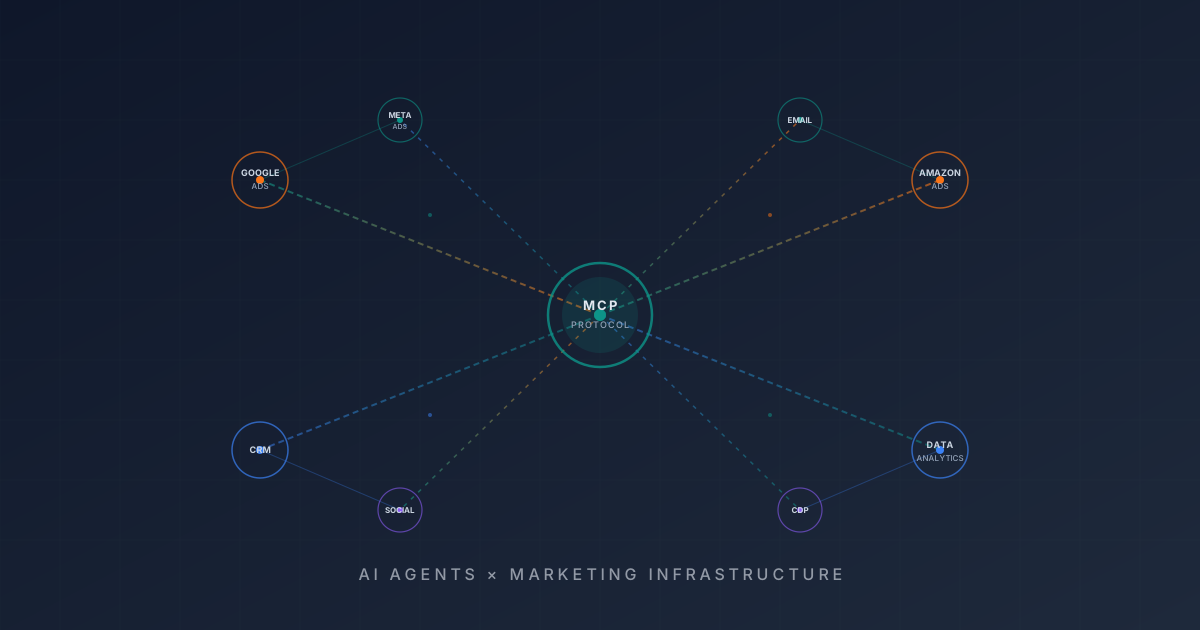
MCP addresses this with a deceptively simple premise: instead of building a bespoke connector for every tool an AI agent needs to use, define a universal protocol that any tool can implement and any agent can consume. Three primitives (Tools for executable functions, Resources for structured data, and Prompts for interaction templates) and suddenly the AI assistant that writes your email copy can also query your campaign performance data and adjust bids, all within the same conversation.
Amazon puts its ad stack on the protocol
The moment MCP went from “interesting spec” to “something marketers need to know about” was when Amazon Ads released its MCP server in open beta.
The move made Amazon one of the first major ad platforms to ship an official MCP implementation. Alex Brockhoff, senior technical product manager at Amazon Ads, framed it this way: “MCP adds a contextual layer that makes capabilities easily usable by AI agents.” That “contextual layer” distinction matters. Raw API access gives an agent the ability to do things. MCP gives it the understanding of what to do and how to do it safely.
Here’s what that looks like in practice. A marketer using Claude, ChatGPT, or any MCP-compatible AI assistant can type something like: “Create a Sponsored Products campaign for my new line of wireless earbuds, targeting mid-range keywords, with a $75 daily budget and automatic bidding.” The MCP server translates that natural language instruction into the sequence of API calls required to set up the campaign, configure the ad group, select targeting parameters, and submit the ad for review. All in one shot. What used to require a developer, or at minimum an ads manager who’d memorized Amazon’s campaign structure, now happens in the time it takes to type a sentence.
Amazon recently expanded the server to include Amazon Marketing Cloud (AMC) query functionality. That means advertisers can run their saved analytics queries through LLMs and fold those insights directly into their campaign workflows. Ask your AI assistant “which audiences drove the highest ROAS on my headphone campaigns last quarter” and get an answer pulled straight from AMC, no SQL required.
The server is available globally to Amazon Ads partners with active API credentials. The fact that Amazon went with open beta (not a closed pilot) signals confidence that the infrastructure is ready for real workloads.
Hector AI: What building on top of MCP actually looks like
If Amazon’s MCP server is the platform layer, Hector AI shows what the application layer looks like when someone builds directly on top of it.
Hector AI, a commerce media platform focused on Amazon Ads optimization, layered its entire optimization suite atop Amazon’s MCP server. CEO Meher Patel described the architectural thinking behind the approach: “This separation lowers friction, preserves accuracy and allows us to move faster without duplicating execution logic.”
That sentence deserves unpacking. “Without duplicating execution logic” is the key phrase. Before MCP, a company like Hector would need to build and maintain its own integration with Amazon’s advertising APIs: authentication, rate limiting, data formatting, error handling, all of it. With MCP, Amazon handles the execution layer. Hector focuses entirely on what it’s actually good at: optimization intelligence.
The result is what Hector calls a “hybrid MCP architecture.” Amazon’s MCP server handles the transactional stuff: Creating campaigns, pulling performance data, executing changes. Hector’s intelligence layer sits on top, providing the analysis, the recommendations, the pattern recognition across historical data. The two communicate through the protocol, each doing what it does best.
This is the pattern that makes MCP interesting beyond individual integrations. It’s not just about connecting an AI to one platform. It’s about creating a stack where different layers of intelligence can compose with each other. The ad platform provides execution, the optimization tool provides strategy, and the AI agent orchestrates the workflow. Nobody had to build a custom integration between Hector and Amazon’s API. The protocol handled the plumbing.
According to Hector’s team, this shift moves them from “dashboard-centric optimization” to “workflow-centric decision systems.” Performance insights aren’t siloed in a dashboard anymore. They flow into whatever environment the marketer is actually working in, whether that’s an AI assistant, a planning document, or a Slack channel with an agent bot.
Beyond Amazon: The MCP marketing stack takes shape
Amazon may be the highest-profile MCP adopter in advertising, but the broader ecosystem has been moving fast.
Third-party MCP servers now cover the major ad platforms. Meta Ads has multiple community-built MCP implementations, including servers from Pipeboard and GoMarble, that let AI agents create campaigns, manage ad sets, and pull performance insights from Facebook and Instagram through natural language. Google Ads integrations are available through platforms like Windsor.ai and Adzviser, which also handle cross-platform attribution.
The cross-platform piece is where things get interesting. Windsor.ai built its MCP connector around attribution modeling. A marketer can ask their AI assistant “How did my Meta ads contribute to my Google search conversions?” and get an answer that accounts for multi-touch attribution, the kind of analysis that previously required a dedicated analytics team or an expensive attribution platform.
Adzviser took a different angle, focusing on real-time budget monitoring. Their MCP integration lets AI agents track daily and monthly ad spend against limits across Google and Meta simultaneously. No more logging into two dashboards to check whether you’re pacing correctly.
These aren’t theoretical demos. Pipeboard’s documentation shows MCP servers managing campaigns across Google, Meta, LinkedIn, Reddit, and TikTok through a single AI agent interface. One prompt, five platforms, unified reporting.
What this actually changes for marketing teams
Here’s what changes and what doesn’t when marketing workflows run through MCP.
What changes:
A single natural-language prompt can spin up a campaign with targeting, budgets, and creative parameters across multiple platforms. The marketer still reviews and approves, but the grunt work of configuration vanishes.
Cross-platform reporting becomes conversational. Instead of exporting CSVs and building pivot tables, marketers ask questions in plain English and get answers that pull data from every connected platform. “What was my blended ROAS across Amazon and Meta last week?” returns an answer, not a link to a dashboard.
Re-engagement workflows get automated end-to-end. Identify customers who haven’t engaged in 30 days, segment by lifetime value, generate personalized email sequences, and trigger the send, all from a single conversation with an AI agent connected to your CRM and email platform via MCP.
Creative testing cycles accelerate. AdSkate’s MCP integration lets advertisers test campaign creatives against over 1,000 synthetic audiences through conversational AI. The feedback loop that used to take days of A/B testing now runs in minutes.
What doesn’t change:
Strategy still requires human judgment. MCP makes execution faster, but deciding which audiences to target, what message to lead with, and how much to spend still depends on understanding your market, your brand, and your customers in ways that no protocol can automate.
Creative quality still matters. Automating campaign setup doesn’t mean automating good advertising. The brands that win will still be the ones with sharper positioning and more resonant creative. MCP just gets it in front of audiences faster.
The adoption numbers tell a clear story
The macro trend lines reinforce what’s happening at the platform level.
Gartner projects that by 2028, 33% of enterprise software will include agentic AI, up from less than 1% in 2024. That’s a staggering growth curve, and marketing technology sits squarely in the path of adoption.
But Gartner’s other prediction deserves equal attention: More than 40% of agentic AI projects will be canceled by end of 2027 due to escalating costs, unclear business value, or inadequate risk controls. That’s not a contradiction. It’s a filter. The projects that survive will be the ones built on solid infrastructure rather than hype-driven experimentation.
MCP is increasingly looking like that solid infrastructure. The protocol’s adoption trajectory has been striking: Thousands of community-built servers, SDKs in every major programming language, and buy-in from OpenAI, Google DeepMind, and essentially every significant AI provider. It’s become the de facto standard for agent-to-tool communication in under two years, a pace that recalls how OAuth became the authentication standard after years of companies rolling their own login systems.
Meanwhile, Gartner separately predicts that 40% of enterprise apps will feature task-specific AI agents by the end of 2026, up from under 5% in 2025. Marketing applications, with their repetitive workflows, data-heavy decision-making, and clear ROI metrics, are a natural fit for that first wave.
The integration tax is going away
Here’s the part that rarely gets discussed in marketing technology coverage but matters more than any feature announcement: Integration cost.
The average mid-market marketing team runs between eight and twelve tools. Each tool-to-tool connection, whether built with APIs, Zapier, or manual exports, carries what you might call an “integration tax.” Developer time to build it. Maintenance time when endpoints change. Troubleshooting time when data stops syncing at 2 AM on a Friday before a big campaign launch.
MCP doesn’t eliminate the need for integration. But it standardizes the interface. A tool that implements the MCP server spec becomes accessible to any AI agent that speaks the protocol, not just agents that someone specifically integrated with that tool. Build the MCP server once, and every AI assistant on the planet can use it.
For marketing teams, this means the marginal cost of adding a new tool to your AI-powered workflow drops close to zero. Want to add TikTok Ads to the same agent that already manages your Google and Meta campaigns? If there’s an MCP server for TikTok (there is), it’s a configuration change, not a development project.
This dynamic also shifts power toward smaller, specialized tools. A two-person startup building an audience segmentation tool can ship an MCP server and immediately become accessible to every AI agent in the ecosystem. They don’t need partnerships with major platforms or enterprise sales teams. The protocol is the distribution channel.
What comes next
If you’re running marketing campaigns today and haven’t looked at MCP, you’re not behind yet. But the window is narrowing.
The immediate opportunity is straightforward: Connect your AI assistant to your ad platforms through existing MCP servers and start automating the repetitive parts of campaign management. Amazon’s server is in open beta. Google and Meta connectors are available from multiple providers. The setup is measured in minutes, not months.
The bigger opportunity is architectural. MCP enables a fundamentally different way of organizing marketing operations, one where AI agents handle execution, optimization tools handle intelligence, and humans handle strategy. The teams that figure out this division of labor early will have a structural advantage over teams that are still switching between tabs and formatting spreadsheets.
One cautionary note: Deloitte’s research on agentic AI adoption makes clear that technology alone isn’t the bottleneck. Process re-engineering, platform modernization, and organizational readiness matter just as much. The teams that adopt MCP most successfully won’t be the ones that bolt AI agents onto existing workflows. They’ll be the ones that redesign their workflows around what the agents make possible.
The protocol is open. The servers are shipping. The teams adopting now are already building workflows that their competitors will spend the next year trying to replicate.