
YouTube Has 31 Million Channels. Zero Intelligence APIs. Here's Why That's Changing.
Every major digital channel has API-first intelligence tools, except YouTube. Here's why that gap exists and how an intelligence layer changes everything.
On this page
YouTube Has 31 Million Channels. Zero Intelligence APIs. Here’s Why That’s Changing.
If you build software that touches SEO, you have Semrush, Ahrefs, and DataForSEO. Structured APIs with keyword difficulty scores, SERP analysis, backlink intelligence, and content gap data. Plug in, get insights, build.
If you build software that touches paid ads, you have Foreplay, AdCreative, and SpyFu. Creative intelligence, competitor analysis, spend estimates. API-first or close to it.
Social media? Phyllo, Modash, and Brandwatch give you structured influencer data, audience demographics, and performance benchmarks across Instagram, TikTok, and Twitter, all through clean APIs.
Now try building software that touches YouTube.
You get the YouTube Data API. It returns raw numbers: View counts, subscriber counts, video titles, publication dates. No scores. No analysis. No intelligence.
Want to know if a video title is good? Build your own model. Want to find underserved content opportunities? Build your own pipeline. Want to benchmark a channel against competitors? Do the math yourself.
YouTube is the second-largest search engine, the dominant video platform, and a $50B+ advertising market. It has 31 million active channels. And until now, it had zero intelligence APIs.
The Gap
Let’s map the intelligence layer across digital channels:
| Channel | Raw Data | Intelligence Layer |
|---|---|---|
| SEO | Google Search Console | Semrush, Ahrefs, DataForSEO |
| Paid Ads | Google/Meta Ads API | Foreplay, SpyFu, AdCreative |
| Social Media | Platform APIs | Phyllo, Modash, Brandwatch |
| ESP APIs | Mailcharts, EmailOctopus | |
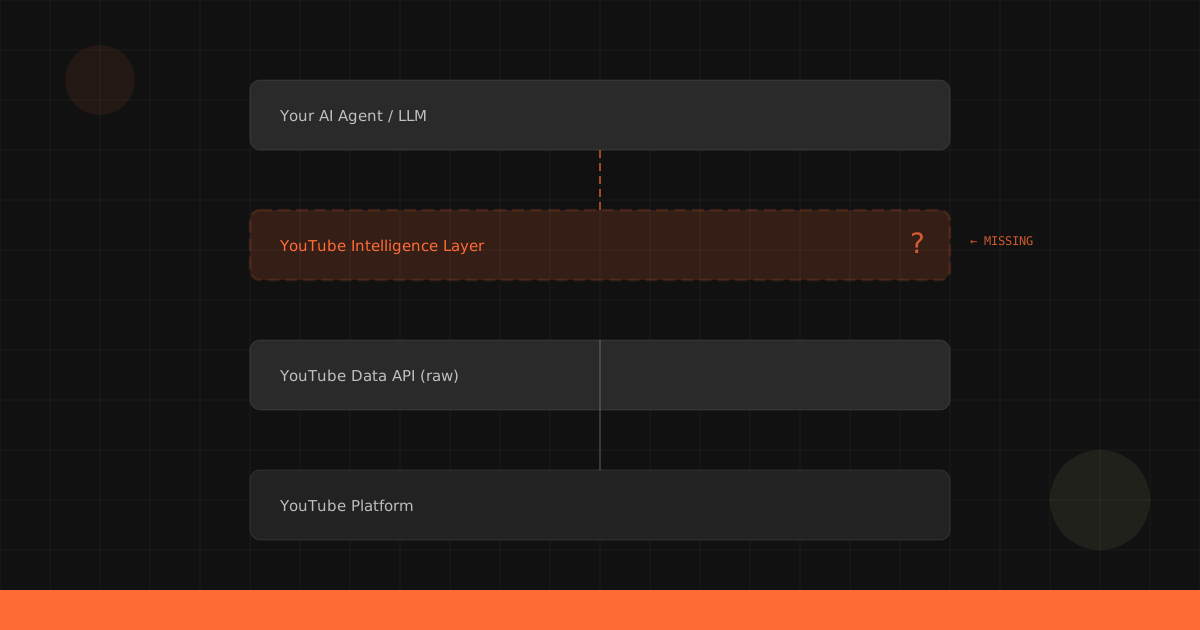
| YouTube | YouTube Data API | ??? |
Every major digital channel has both a raw data layer and an intelligence layer built on top of it. YouTube has only the raw data.
This means every developer, agency, and tool builder who wants YouTube intelligence has two choices:
- Build it yourself: Stand up data pipelines, train models, maintain classification systems, and keep everything updated as YouTube’s ecosystem evolves.
- Go without: Use raw metrics and hope for the best.
Both options are bad. Option 1 is a massive engineering lift that distracts from your actual product. Option 2 means making decisions without data.
Why This Gap Exists
YouTube’s ecosystem was built for creators, not developers.
The tools that dominate YouTube (vidIQ, TubeBuddy, Morningfame) are browser extensions and dashboards designed for individual creators. They’re excellent at what they do. But they share a fundamental limitation: None of them offer an API.
You can’t plug vidIQ into your AI agent. You can’t call TubeBuddy from a workflow automation. You can’t embed Morningfame’s intelligence into your SaaS product. They’re walled gardens optimized for human eyeballs, not programmatic access.
This made sense in 2015 when YouTube tools were simple keyword browsers. It doesn’t make sense in 2026 when:
- AI agents need structured data, not dashboards
- Workflow automation (n8n, Zapier, Make) needs API endpoints, not browser extensions
- SaaS builders want to embed intelligence, not redirect users to another product
- Agencies managing 50 channels need programmatic access, not 50 open browser tabs
The creator-tool era built intelligence but locked it behind UIs. The developer era needs that intelligence exposed through APIs.
What an Intelligence Layer Looks Like
The difference between raw data and intelligence is the difference between ingredients and a meal.
Raw data (YouTube Data API):
{
  "viewCount": "142000",
  "likeCount": "8200",
  "commentCount": "340",
  "publishedAt": "2026-02-15T14:00:00Z"
}
You can see numbers. You can’t see whether those numbers are good, bad, or average for this niche. You can’t see what’s missing from the existing content. You can’t see what title would perform better.
Intelligence (BrightBean):
{
  "topic": "resistance band back workouts",
  "demand_score": 82,
  "supply_gap": 0.73,
  "opportunity_rating": "high",
  "search_volume_trend": "rising",
  "suggested_angle": "Complete back workout using only resistance bands"
}
This is an opinion backed by data. It says: “Here’s a topic worth making a video about, here’s why, and here’s the angle that’s underserved.” That’s intelligence.
Intelligence means:
- Scores, not just counts: Is a title good? Is a thumbnail effective? Is a hook strong?
- Rankings, not just lists: Where does this channel sit relative to competitors?
- Gaps, not just coverage: What’s missing in this niche?
- Predictions, not just history: How will this title likely perform?
- Recommendations, not just observations: What should you do next?
What This Enables
An intelligence API unlocks use cases that raw data simply can’t serve.
AI Agents
The fastest-growing use case. AI agents built with LangChain, CrewAI, AutoGen, or custom frameworks need tools, and tools need structured API endpoints. An agent can’t interpret a dashboard, but it can call /v1/research/content-gaps, reason over the response, then call /v1/score/packaging to evaluate options.
The pattern:
Agent receives: "Plan next month's content for a cooking channel"
Agent calls: /v1/research/content-gaps → gets opportunities
Agent reasons: selects top 8 topics
Agent calls: /v1/score/packaging (x24) → scores 3 titles per topic
Agent outputs: prioritized 4-week calendar with scored titles
This workflow is impossible without an intelligence API. With one, it takes 30 seconds.
For a working example, see: How to Build a YouTube Content Planning Agent
Embedded Intelligence
SaaS products that touch YouTube (social media management tools, creator economy platforms, video editing software) can embed BrightBean’s intelligence directly:
- A video editor that scores your title as you type it
- A social media dashboard that flags content opportunities
- A creator platform that benchmarks channels on sign-up
- A thumbnail design tool that scores variations before export
None of this is possible with dashboard-only tools. All of it is straightforward with an API.
Workflow Automation
Marketing teams and agencies use workflow tools (n8n, Zapier, Make) to automate repetitive tasks. With an intelligence API, you can automate YouTube strategy:
- Weekly content gap scan → results posted to Slack
- Title scoring before every upload → integrated into your publishing workflow
- Competitor monitoring → alerts when a competitor’s strategy shifts
See: How to Automate YouTube Competitor Monitoring
MCP and Desktop AI
Model Context Protocol (MCP) enables AI assistants like Claude Desktop to call external tools during conversation. With BrightBean as an MCP server, you can ask Claude natural-language questions about YouTube strategy and get data-backed answers in real time.
See: How to Connect YouTube Intelligence to Claude Desktop via MCP
The API-First Shift
The pattern is clear across every digital channel:
- Raw data APIs emerge first (platform APIs)
- Dashboard tools aggregate and visualize the data (for humans)
- Intelligence APIs structure the data into scores, rankings, and recommendations (for software)
SEO went through this cycle: Google Search Console → Moz/SEMrush dashboards → DataForSEO/Semrush API. Social media went through it: Platform APIs → Sprout/Hootsuite dashboards → Phyllo/Modash APIs.
YouTube is entering phase 3. The dashboard era (vidIQ, TubeBuddy) served creators well. The intelligence API era serves everyone: Creators, developers, agents, and platforms.
What BrightBean Provides
BrightBean is the intelligence layer for YouTube. Here’s what the API offers:
| Endpoint | What It Does | Use Case |
|---|---|---|
/v1/research/content-gaps |
Finds underserved topics in a niche | Content planning, opportunity research |
/v1/research/niches |
Lists catalogued YouTube niches | Niche discovery, slug lookup |
/v1/score/packaging |
Scores a title and/or thumbnail for CTR | Packaging optimization, A/B testing |
/v1/score/video-hook |
Classifies and scores video hooks | Retention optimization |
/v1/benchmark/channel |
Compares a channel against its niche | Competitive intelligence |
/v1/benchmark/video |
Compares a video against its niche | Post-publish performance assessment |
Every endpoint returns structured JSON with scores, subscores, and actionable recommendations. No dashboard required. No browser extension needed. Just HTTP requests and structured responses.
Authentication is a single API key. Rate limits are generous. The free tier includes 350 credits, enough to build, test, and validate your integration before scaling.
The Opportunity
YouTube’s intelligence gap is a structural market failure. Trillions of views happen on a platform where the best available intelligence is locked behind browser extensions.
As AI agents become the primary interface for content strategy, and as workflow automation becomes standard practice for professional creators and agencies, the need for programmatic YouTube intelligence will only grow.
The dashboard era built the models. The API era makes them accessible to software.
Related Reading
- YouTube Data API vs Intelligence API, What’s the Difference?, A detailed technical comparison
- How AI Agents Are Changing YouTube Content Creation in 2026, The broader trend driving demand for intelligence APIs
- How to Build a YouTube Content Planning Agent, See the intelligence layer in action
Build with YouTube intelligence. Get your free BrightBean API key, 350 credits, no credit card required. Start building at brightbean.xyz.