
Why the MCP Server Is Replacing the Traditional Data Feed
Traditional data feeds are buckling under the weight of AI-native workflows. MCP servers offer a smarter, context-aware alternative that's already reshaping how financial services, SaaS platforms, and enterprise teams consume data.
 Jan Schmitz
|
|
11 min read
Jan Schmitz
|
|
11 min read
On this page
TL;DR: The traditional data feed (batch-processed, one-size-fits-all, firehose of information) is hitting a wall. As AI agents become the primary consumers of enterprise data, they need something smarter: Context-aware, secure, on-demand access that speaks their language. MCP (Model Context Protocol) servers are filling that gap. With 97 million monthly SDK downloads, backing from every major AI vendor, and real-world deployments like Dakota’s investment data platform, MCP is quickly becoming the new plumbing layer between AI systems and the data they depend on.
Why the MCP Server Is Replacing the Traditional Data Feed
There’s a quiet infrastructure shift happening underneath the AI hype cycle, and most people outside of data engineering circles haven’t noticed it yet.
For decades, the data feed has been the workhorse of enterprise information delivery. Stock prices, weather data, CRM updates, market research. If a system needed external data, it subscribed to a feed. The feed pushed. The system consumed. Simple, reliable, and limited in ways that didn’t matter until about eighteen months ago.
What changed? AI agents started showing up at the table, and they turned out to be terrible feed consumers.
An AI agent doesn’t want a CSV dump at 6 AM. It doesn’t want 47 fields when it only needs three. It certainly doesn’t want to parse five different proprietary formats from five different vendors just to answer a single question about a portfolio manager’s track record. What it wants is to ask a question and get a precise, authenticated, contextual answer in real time.
That’s the gap MCP servers are filling. If you work in financial services, SaaS, or any data-heavy vertical, pay attention.
The data feed had a good run
Let’s give credit where it’s due. Traditional data feeds built modern finance. Bloomberg terminals, Reuters tickers, SWIFT messaging. These systems moved trillions of dollars worth of decisions every day. They still do. The architecture is proven: A provider packages data into a standardized format, pushes it on a schedule (or streams it continuously), and consumers ingest it into their own systems for processing.
The problem isn’t that feeds stopped working. The problem is that the consumers changed.
When the primary consumer was a database, a spreadsheet, or a dashboard, feeds were fine. The data arrived, got stored, got queried later. Latency was acceptable. Format mismatches were annoying but manageable. You wrote a parser, maybe hired a consultant, moved on.
But AI agents operate differently. They don’t batch-process. They reason across multiple data sources simultaneously. They need to verify permissions in real time. They ask follow-up questions. They need context about what the data means, not just what it contains.
According to McKinsey’s research on financial data infrastructure, the average financial institution operates with disparate systems and applications, each with its own data format. This fragmentation has always been painful. With AI agents trying to reason across those systems, it becomes a blocker.
Gartner estimates that organizations in the financial sector lose an average of $15 million annually due to poor data quality alone. That number gets worse when you factor in the cost of maintaining dozens of custom integrations between data feeds and the tools trying to use them.
Enter the MCP server
The Model Context Protocol started as Anthropic’s answer to a specific engineering headache: The N×M integration problem. If you have N AI tools and M data sources, you traditionally need N×M custom connectors. Every new tool or data source multiplies the integration burden.
MCP collapses that into N+M. Every AI client speaks the same protocol. Every data source exposes the same interface. Connect once, work everywhere.
That was the pitch in November 2024. Eighteen months later, it’s infrastructure. The protocol has crossed 97 million monthly SDK downloads across Python and TypeScript. There are over 10,000 active public MCP servers. Every major AI platform (ChatGPT, Claude, Gemini, Microsoft Copilot, Cursor, VS Code) speaks MCP natively.
And in March 2026, Anthropic donated the entire protocol to the Agentic AI Foundation under the Linux Foundation, co-founded with OpenAI and Block. MCP is no longer one company’s project. It’s an industry standard with the same institutional backing as Linux and Kubernetes.
MCP didn’t grow because of marketing. It grew because developers kept running into the same wall. They had an AI agent that needed to talk to a database, or a CRM, or a document store, and every integration was a bespoke nightmare. MCP gave them a standard way to solve that problem.
How MCP servers actually work (and why it matters for data delivery)
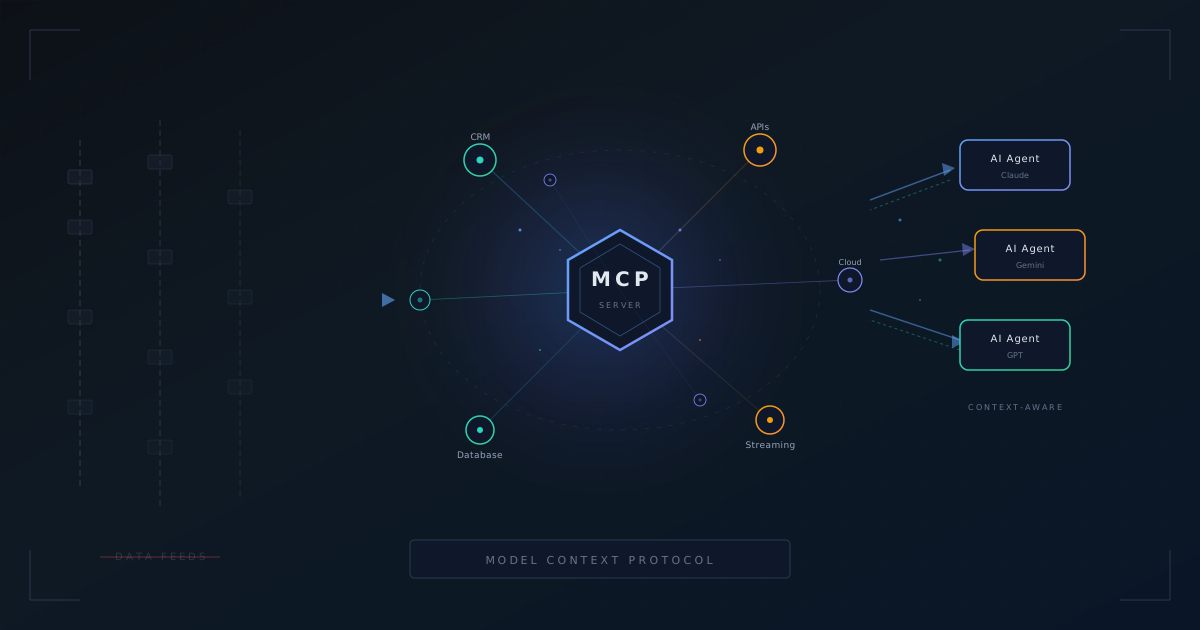
An MCP server isn’t a database. It’s not an API gateway, exactly, though it shares some DNA with one. Think of it as a context-aware translator that sits between an AI agent and a data source.
The key architectural differences from traditional feeds:
Queries are consumer-driven, not provider-driven. A traditional feed says: “Here’s everything, figure out what you need.” An MCP server waits for the AI agent to ask a specific question, then returns precisely what’s relevant.
Instead of hitting a fixed endpoint like /api/v2/funds?strategy=PE&vintage=2024, an AI agent can express intent: “Find mid-market private equity funds raised in the last two years with at least $500M AUM.” The MCP server interprets that and translates it into the appropriate queries.
Per-user security is enforced natively. This is a big deal for regulated industries. Every query through an MCP server can run under the authenticated user’s credentials. Sharing rules, field-level security, role-based access are all enforced at the server level, not bolted on after the fact.
MCP also supports stateful, bidirectional communication: Streaming updates, progress notifications, partial results, clarifying questions, and real-time updates. Traditional request-response APIs and batch feeds can’t do any of that.
Production MCP servers typically include intelligent caching (search results cached for a couple of minutes, profile lookups cached longer) and tiered rate limiting to prevent abuse without sacrificing responsiveness.
Dakota’s bet: A case study in MCP-native data delivery
Dakota, the investment research and institutional sales intelligence platform, offers one of the clearest examples of what this shift looks like in practice.
Dakota Marketplace provides fund manager data, allocator intelligence, and contact information to investment professionals. This is the kind of data that traditionally lived in spreadsheets, CRM exports, and data feeds. Their platform already integrates with Salesforce, providing data directly within CRM workflows.
But they’ve gone further. Dakota built an external-facing MCP server that lets any MCP-compatible AI client (Claude, ChatGPT, Cursor, whatever) query Dakota Marketplace data directly. The architecture is clean: A Node.js/Express server handles MCP protocol communication, authenticates users via OAuth 2.0 with PKCE against Salesforce, stores sessions in Redis, and routes queries through the Salesforce REST API.
What can you actually do with it? Search for fund managers by name, AUM, strategy, or geography. Find allocators filtered by type, location, and capital size. Pull fund data by strategy, vintage year, and manager. Retrieve contacts. Run free-text searches across all entities.
Every single query runs as the authenticated customer. Salesforce sharing rules and field-level security are enforced natively, by the actual Salesforce security model, not through some middleware layer. A standard tier user gets 100 requests per hour. Premium gets 500. Results are cached intelligently: 120 seconds for searches, 300 seconds for profile lookups.
This is what “the future of the data feed” actually looks like. Not a flat file delivered at midnight. Not a REST API that returns the same JSON blob regardless of who’s asking. A contextual, secure, AI-native interface that lets the consumer ask for exactly what they need, verified against exactly what they’re allowed to see.
The N×M problem was always the real bottleneck
If you’ve worked in enterprise data integration, you know the pain. Every vendor has their own format. Every system has its own authentication. Every integration is a snowflake.
Insight Partners’ research on financial services data paints a familiar picture: Organizations spend enormous resources just getting data from point A to point B in a usable format. The actual analysis (the part that creates value) happens on whatever time and budget is left over.
MCP doesn’t eliminate all of that complexity. The underlying data sources still exist. The APIs still need to work. But it standardizes the last mile: The interface between the data and the thing trying to use it. For AI agents, that last mile was the entire bottleneck.
Before MCP, a developer building an AI-powered investment research tool needed separate integrations for their CRM data, their market data provider, their document management system, and their compliance database. Each integration had its own authentication flow, its own data format, its own error handling, its own maintenance burden. Add a new data source? That’s another month of engineering work.
With MCP, each of those data sources exposes a single standardized interface. The AI agent connects to each one the same way. Add a new source? Configure another MCP server. The agent discovers its capabilities automatically.
The enterprise adoption curve is steeper than you’d think
The numbers tell a story of unusually fast enterprise uptake. According to CData’s analysis, approximately 28% of Fortune 500 companies had implemented MCP servers in their AI stacks by early 2025, up from just 12% the year before. Fintech leads adoption at 45%, followed by healthcare at 32% and e-commerce at 27%.
Industry projections suggest the MCP server market will reach $10.4 billion by 2026, growing at a 24.7% CAGR. By the end of 2026, analysts expect 75% of API gateway vendors and 50% of iPaaS vendors to have MCP features baked into their products.
Those numbers matter because they signal something beyond a technical trend. When API gateway vendors start building MCP support into their core products, that’s the infrastructure layer signaling a permanent shift. Data feeds aren’t disappearing overnight. Legacy systems and existing contracts ensure that. But the growth vector has shifted.
What MCP still needs to get right
It would be dishonest to present MCP as a finished product. The protocol has real gaps, and the community knows it.
Security maturity varies wildly. Dakota’s implementation, with its proper OAuth flow and native Salesforce security enforcement, is best practice. Many MCP servers in the wild don’t come close. The 2026 MCP roadmap explicitly calls out the need for standardized security patterns.
Server discovery is still immature. Finding available MCP servers and understanding their capabilities before connecting to them requires a live connection in most cases. The roadmap includes a standard metadata format that can be served via .well-known, but it’s not widely implemented yet.
Task lifecycle management needs work. What happens when a long-running MCP task fails partway through? Retry semantics, expiry policies for completed results, and graceful degradation are all areas under active development.
Governance is evolving. The Agentic AI Foundation is brand new. Its working groups, specification enhancement proposals, and decision-making processes are still being established. The protocol needs to be governed well for a long time to earn the trust of enterprises that are betting their data infrastructure on it.
These aren’t fatal flaws. They’re the growing pains of a protocol that went from zero to industry standard in about 18 months. But they do mean that organizations adopting MCP today need to be thoughtful about implementation, especially around security and error handling.
The real shift: Data consumers are becoming data conversationalists
The deeper point gets lost in the protocol specifications and market projections.
Traditional data feeds treated the consumer as a passive recipient. Data arrived. You processed it. The relationship was one-directional and transactional.
MCP servers treat the consumer as an active participant in a conversation. The AI agent can ask questions, refine queries, request clarification, and build understanding incrementally. The data source can push updates, flag anomalies, and provide context that wasn’t explicitly requested.
That changes the economics of data delivery. In the old model, providers competed on coverage and speed: Who has the most data, delivered the fastest. In the MCP model, providers compete on intelligence: Who provides the most useful, contextual, actionable responses to the questions that actually matter.
Dakota’s move illustrates this perfectly. They’re not just exposing their data through a new pipe. They’re making their data conversational: Queryable by intent, secured per user, and accessible from any AI client without custom integration work.
For investment professionals, that’s the difference between “download this spreadsheet and build your own analysis” and “ask me anything about the managers, allocators, and funds in your universe, and I’ll answer within your permission boundaries.” One of those approaches scales with AI. The other doesn’t.
What this means for data providers and consumers
If you’re a data provider, start thinking about your MCP strategy now. The question isn’t whether your customers will expect MCP-compatible access to your data, but when. The companies moving first (Dakota, Confluent, Databricks, and others) are establishing patterns that will become baseline expectations.
Building an MCP server doesn’t mean abandoning your existing APIs or feed infrastructure. MCP servers typically sit on top of existing APIs as an orchestration layer. But it does mean investing in the interface that AI-native workflows actually want to use.
If you’re a data consumer, evaluate your current data integration stack through the lens of AI readiness. How many custom integrations are you maintaining? How much engineering time goes into keeping feeds working versus actually using the data? MCP won’t solve all of that overnight, but it provides a migration path toward a world where adding a new data source to your AI workflows takes hours instead of months.
If you’re in financial services, pay close attention to the security model. Dakota’s approach (running every query under the authenticated user’s Salesforce credentials) sets a standard that regulators will likely come to expect. If your MCP implementation can’t demonstrate per-user access controls and audit trails, it’s not ready for production in regulated environments.
Looking ahead
The data feed isn’t dead yet. Bloomberg terminals aren’t going anywhere this quarter. But the trajectory is clear. The primary consumer of enterprise data is shifting from humans-with-dashboards to AI-agents-with-context-windows. And those agents need a fundamentally different delivery mechanism than what feeds provide.
MCP servers are that mechanism. They’re not perfect, and they’re not finished. But they’re standardized, they’re backed by every major player in the AI ecosystem, and they’re already deployed at scale by companies that can’t afford to get data delivery wrong.
The future of the data feed is a conversation, not a broadcast. The organizations that figure that out first will have a structural advantage, not because they have better data, but because their data is more usable by the systems that increasingly make the decisions.
Sources: Anthropic MCP Announcement, Agentic AI Foundation, Dakota MCP Server, CData Enterprise MCP Adoption, MCP 2026 Roadmap, McKinsey Financial Data Infrastructure, Confluent MCP Integration