
Social media optimisation: What it is and what to improve first
Learn what social media optimisation covers, what to improve first, and how to connect platform fit, content, sharing, measurement and tools into one loop.

On this page
A full social queue can still leave your best post hard to find and disconnected from what you publish next. Social media optimisation is the practice of improving that whole path: choose a platform your audience uses, shape the post for that platform, make the next action clear, and learn from the response.
That is why SMO is more useful as a working loop than as a list of hashtag tricks.
TL;DR
- Start with the audience and platform, not a universal posting formula.
- Adapt the opening, format, visual and next action to the network.
- Use hashtags and sharing to support discovery, then test what changes.
- Review shares, saves, replies, profile visits and clicks as clues for the next post.
- Use a tool when it removes broken handoffs between context, creation, approval, publishing and learning.
What social media optimisation actually improves
Social media optimisation, usually shortened to SMO, is the deliberate improvement of social content and the path around it. It covers choosing a relevant audience and platform, creating content that fits the platform, encouraging useful interaction and sharing, and learning from what happens next. West Virginia University’s overview of social media optimisation describes the practice in similar terms: creation, curation and promotion designed to improve an organisation’s online presence and reputation.
SEO mainly helps web pages become discoverable in search. SMO applies a similar discipline to social content and the actions around it. The two can support each other: a social post can bring someone to a useful page, while that page can give you material to adapt for social. Neither makes the other automatic.
Think of SMO as a loop:
- Audience: Who should care about this idea?
- Platform: Where does that audience already pay attention?
- Post: What format and opening fit that platform?
- Action: What should someone do next?
- Feedback: What will you change in the next version?

The useful question is not “How do I get more reach?” It is “Which part of this loop is stopping the right person from taking the next useful action?”
Start with the platform your audience already uses
A platform is a starting decision, not a loyalty test. West Virginia University’s guidance recommends considering audience personas, where those people spend time, the business model and the product before choosing a network. Use that filter before you build a calendar.
- Choose one or two networks with a clear reason. “Everyone is there” is not a reason you can act on.
- Give each network a job. One might be for expert explanation, another for visual demonstration, and another for conversation.
- Adapt the same idea instead of pasting the same post everywhere. The subject can stay consistent while the opening, length, visual and action change.
For example, a product lesson might become a short point of view on LinkedIn, a visual walkthrough on Instagram or a searchable visual on Pinterest. Those are starting hypotheses, not permanent rules. Review the response and keep the version that helps the intended audience move forward.
Improve the path from feed to action
Once the platform is chosen, improve the post in the order a person experiences it:
- Opening: Name the reader’s problem or desired outcome in the first line.
- Useful middle: Give the reader a complete idea, example or next step inside the post.
- Visual support: Use an image, diagram or video when it makes the idea easier to grasp. Do not make the visual carry information the caption never explains.
- Next action: Ask for one relevant action, such as saving a checklist, replying with a question or visiting a page that continues the promise.
- Destination: Make sure the profile, pinned content or landing page matches what the post promised.
A complete illustrative post
Assume a small marketing agency wants to reach solo founders whose marketing keeps getting pushed aside. It chooses LinkedIn as a starting platform because its audience is active there. The example below shows the decisions, not a guaranteed result.
| SMO decision | Filled-in example |
|---|---|
| Audience | Solo founders who start each post from a blank page |
| Platform assumption | LinkedIn is the first test network |
| Post | “Marketing keeps getting pushed aside because every post starts from a blank page. This week, answer one audience question and adapt it for one platform. Plan the follow-up while the context is fresh.” |
| Next action | “Save this checklist, then reply with the question your audience asks most.” |
| Review signals | Shares, profile visits, replies and link clicks, where a link is part of the post |
Here is the same example as a finished post, rather than a planning description:
LinkedIn post
Marketing keeps getting pushed aside because every post starts from a blank page.
This week, answer one audience question and adapt it for one platform. Plan the follow-up while the context is fresh.
Save this checklist, then reply with the question your audience asks most.
The point is the connected path. A useful sentence without a next step may earn attention but leave the reader nowhere to go. A strong call to action cannot rescue a post that never makes its value clear.
Use hashtags and sharing as distribution levers, not decoration
Hashtags can help categorise a post and make a specific topic easier to find. Use relevant, narrow tags when they add context, and skip tags that only chase a broad trend. A long string of unrelated hashtags makes the post harder to read and gives you no clear test to learn from.
As of October 2024, the WVU overview reported that Instagram posts with a hashtag received about 10% more engagement than posts without one. The page does not name a study behind that figure, so treat it as a dated observation, not a current benchmark or a promise for every account. If you use hashtags, compare similar posts on your own account.
Sharing is another useful test. Invite a relevant colleague, customer or follower to pass on a post when it genuinely answers a question their network has. Make the reason clear: “Send this to the person who keeps rebuilding the content calendar” is easier to act on than “Share this with everyone.”
Run two simple comparisons:
- Publish a useful post with a small set of relevant hashtags, then compare it with a similar post without them.
- Use a specific sharing prompt on one post and no prompt on a comparable post.
Keep the topic, audience and format close enough that the change is worth comparing. If you change everything at once, the result cannot tell you much.
Build a weekly SMO review loop
SMO becomes useful when a published post tells you what to do next. Treat individual signals as clues rather than verdicts, and look at a small run of comparable posts before changing direction.
| Signal | What it may suggest | Next test |
|---|---|---|
| Shares | The idea was easy or useful enough to pass on | Make the insight more specific, or add a clearer reason to forward it |
| Saves | The post has reference value | Turn the idea into a checklist, example or recurring answer |
| Replies | The post raised a question, objection or useful detail | Answer it directly and use the answer as a follow-up topic |
| Profile visits | The topic created interest beyond the post | Tighten the profile promise and the content a new visitor sees first |
| Link clicks | The reader wanted the next step | Align the destination’s headline and action with the post’s promise |
At the end of the week, record one observation and one change. Keep the change small enough to recognise later: a clearer opening, a different visual format, a more specific action or a better-matched destination. Then carry the learning into the next idea instead of starting from a blank page again.

When a tool earns its place
A tool should remove a broken handoff, not add another dashboard. Look for four practical jobs:
- It carries audience, brand and content context between planning and creation.
- It helps adapt one idea for the platforms you actually use.
- It keeps review, approval, scheduling and publishing in a visible workflow.
- It brings performance signals back into the next round of planning.
A narrow scheduler can be the right choice when your only problem is queueing finished posts. A broader setup is worth considering when the harder problem is repeated explanations, scattered drafts, disconnected analytics or content that never informs the next idea.
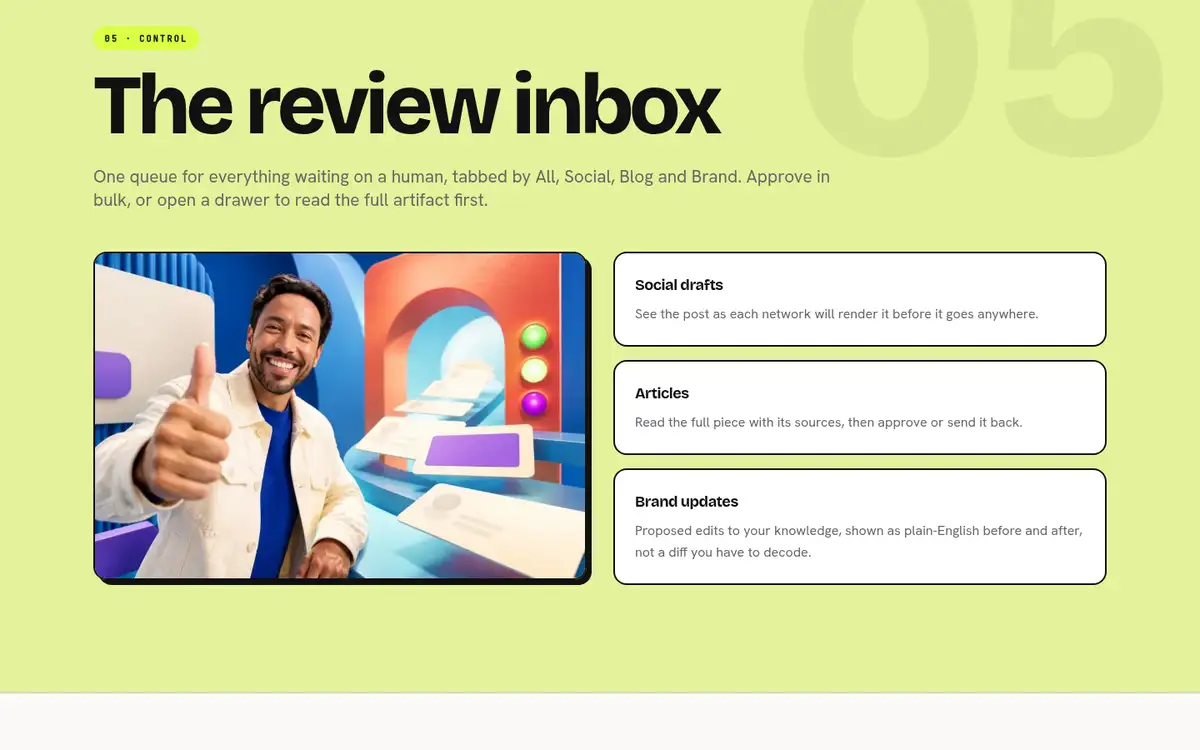
BrightBean is one example of that broader setup. Its documented workflow connects ideation, research, creation, platform adaptation, scheduling, publishing, analytics and performance-informed improvement around shared brand context. It is review-led: people approve drafts and sensitive brand changes before publication. That makes it relevant when the bottleneck is the handoff between tasks, not just the act of pressing Publish. If all you need is a simple queue, a narrower scheduler may be the better fit.
Do not choose by the number of channels alone. A tool that publishes everywhere but makes you restate the audience and brand for every post has not solved SMO’s hardest part: carrying the loop forward.
Frequently asked questions
The numerical labels below are not part of SMO’s definition, and they do not have one shared meaning across social-media advice. Where a canonical definition cannot be supported, the answer gives a clearly labelled routine you can test instead of presenting a number as a law.
What is the 5-5-5 rule for social media?
The 5-5-5 label has no single agreed social-media meaning. Treat it as a planning label, not a universal rule; a practical version is five meaningful comments on five relevant posts on five weekdays. For example, the solo founder in the example could comment on five posts about content capacity each weekday, then review replies and profile visits at the end of the week.
What is the 3-3-3 rule for social media?
The 3-3-3 label also has no single agreed meaning. A practical version is three meaningful comments on three relevant posts across three days each week. Record that definition before you begin, then compare the resulting replies and profile visits with a similar week; this is a test plan, not a promise of reach.
How do I start SEO for beginners?
Start with one clear audience question. Publish a page that answers it directly, put the question’s language in the page title, link to it from a relevant page, and review impressions, clicks and queries before choosing the next topic. For the example above, the question could be “How can a solo founder plan a week of social posts?” The page would answer it, then the LinkedIn post would point readers to that fuller explanation. SEO and SMO can support each other, but improving social posts does not replace improving the page you want found.
What is the 5-3-1 rule on social media?
The 5-3-1 label is used for different routines rather than one universal standard. For a content calendar, use this explicit interpretation: five helpful or curated posts, three original educational posts and one post that points to an offer in a nine-post cycle. It is a planning ratio, not an algorithm signal; if the community using the label gives it another meaning, write that version down before comparing results.
Sources
- Social Media Optimization: An In-Depth Look: https://marketingcommunications.wvu.edu/professional-development/marketing-communications-today/marketing-communications-today-blog/2024/10/16/social-media-optimization-an-in-depth-look. Defines social media optimisation as deliberate creation, curation and promotion, and covers platform choice, visuals, sharing, hashtags, tools, strategy and testing. It also reports an about-10% Instagram hashtag engagement observation.
- BrightBean features: https://brightbean.xyz/features/. Documents BrightBean's connected marketing workflow, shared brand context, review and approval controls, content creation, publishing, analytics and performance-informed improvement.