
A Social Media Scheduler Comparison That Admits Where Competitors Win
A straight look at Buffer, Sendible, Hootsuite, Later, Publer, and BrightBean Studio, including the cases where each competitor is the better choice. Pick the right tool, not the loudest one.
On this page
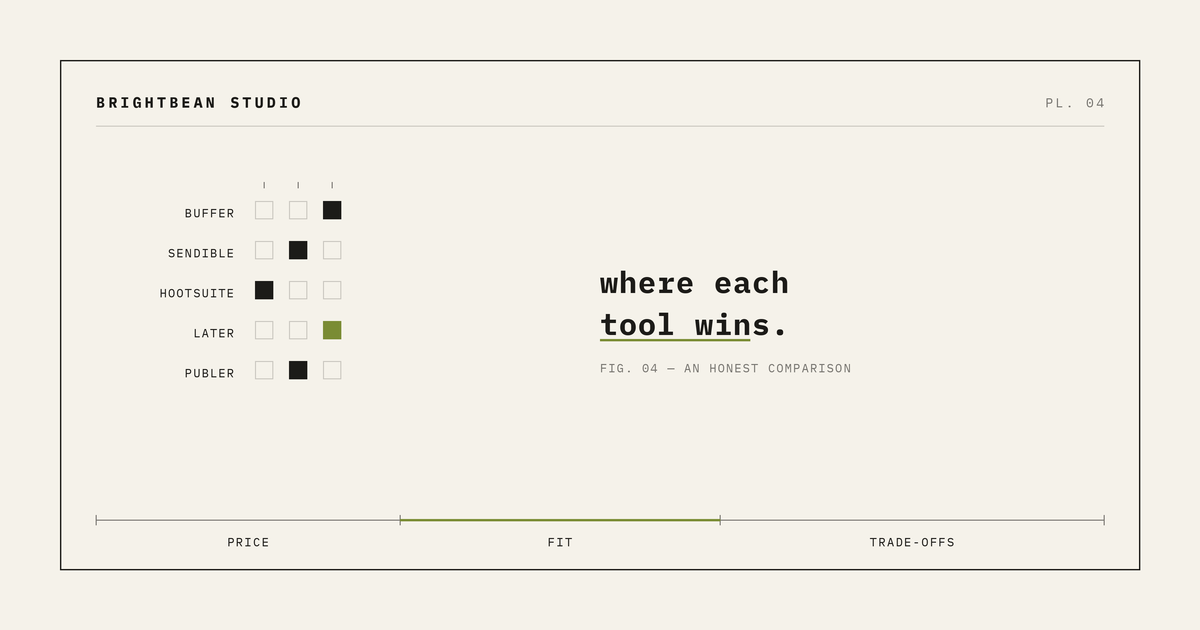
TL;DR: Most scheduler comparisons are advertisements wearing a table. This one tells you when to pick the competitor. Buffer is best for a solo, mobile-first creator on a few channels. Sendible and SocialPilot are built for agencies that want client reporting. Hootsuite has the deepest analytics and the highest price. Later is the best visual planner for Instagram. Publer is the affordable all-rounder and the one that supports X/Twitter. BrightBean Studio is the free, open-source option that wins on channel count, team approvals, and data ownership, and loses on analytics depth, a native app, and X support. Pick the one that fits the job.
The comparison that names where each tool wins
Every “best social media scheduler” post is really a sales page for whatever the author is selling. The table is rigged so one column wins every row. That is not a comparison, it is an advertisement with extra steps, and anyone who has chosen software before can smell it.
So here is the version that names where each tool actually wins, including the ones that are not us. We build BrightBean Studio, a free open-source scheduler, and there are several jobs for which it is the wrong choice. Knowing which is the point.
The pattern that makes this hard
The recurring problem across the paid tools is that the pricing scales with exactly the thing that should get easier as you grow. Per-channel fees grow with your channel list. Per-seat fees grow with your team and punish bringing on a contractor for two weeks. Features you depend on sit behind the next tier up. None of that is a scandal; it is just the SaaS model, and for many people it is worth it. It only becomes a problem at a specific scale, and that scale is where an open-source option starts to make sense.
Where each one wins
Buffer. The most refined simple scheduler, and the free plan covering one to three channels is genuinely hard to beat. Strong iOS and Android apps, a Start Page link-in-bio, and a caption-writing AI that ships today. Choose Buffer if you are a solo creator who lives on mobile and posts to a few channels. See the detailed BrightBean Studio vs Buffer breakdown.
Sendible. Built for agencies, with client management and reporting at its center. Choose Sendible if your work is running social for clients and the reports you hand over matter as much as the posts.
SocialPilot. The affordable agency middle ground, with bulk scheduling and client-friendly features at a lower price than the enterprise tools. Choose it if you want agency features without an enterprise bill.
Hootsuite. The enterprise incumbent. The deepest analytics and social listening in the category, and the highest price to match. Choose Hootsuite if you need serious analytics and listening and have the budget that implies.
Later. The best visual planner, Instagram-first by design, with a strong media library and link-in-bio. For a solo visual creator, Later’s workflow is better than anything we offer. Choose Later if Instagram is your world.
Publer. The affordable all-rounder. Bulk scheduling, a generous feature set, and crucially it supports X/Twitter. Choose Publer if you want low cost, broad platform coverage, and X scheduling in one place.
Where BrightBean Studio fits
Studio is the free, open-source option. It publishes to 11 platforms with a drag-and-drop calendar and a unified inbox, and it gives you multi-workspace approvals and passwordless magic-link client review without a paid tier. It is AGPL-3.0, so you can run the free hosted version or self-host on a VPS for around five dollars a month and own your data outright.
Choose Studio if you schedule across many channels, work with a team or clients and need approvals without per-seat fees, or want to own your data and never be repriced. The trade-offs, plainly: Studio has no analytics dashboard yet, no native mobile app, no link-in-bio page, and no X/Twitter support. If any of those is your deciding factor, one of the tools above is the better call.
The math, plainly
The break-even is not about features, it is about scale. A solo creator on three channels should probably use a free SaaS plan. A small agency on eight clients and thirty-plus channels, paying per channel and per seat, is the case where a free, self-hosted tool with unlimited channels and free approvals changes the numbers. We wrote the full cost audit and the per-competitor tables in the comparison section. Read it, including the parts where we lose, and pick the tool that fits your actual job.