
Fewer Features Than Buffer, On Purpose: How We Built BrightBean Studio in Three Weeks
BrightBean Studio is an open-source Buffer alternative with deliberately fewer features. The reasoning: every feature is a maintenance promise, the stack stays boring, and the price stays zero.
On this page
TL;DR: BrightBean Studio is an open-source social media scheduler with deliberately fewer features than Buffer. Not because we ran out of time, but because a two-person team treats every feature as a years-long maintenance promise. It does scheduling, a calendar, a unified inbox, and multi-workspace approvals well, on a boring Django and HTMX stack, free and AGPL-3.0. It skips analytics dashboards, an AI caption writer, a link-in-bio page, and Twitter/X. Here is the reasoning, including where Buffer is still the better choice.
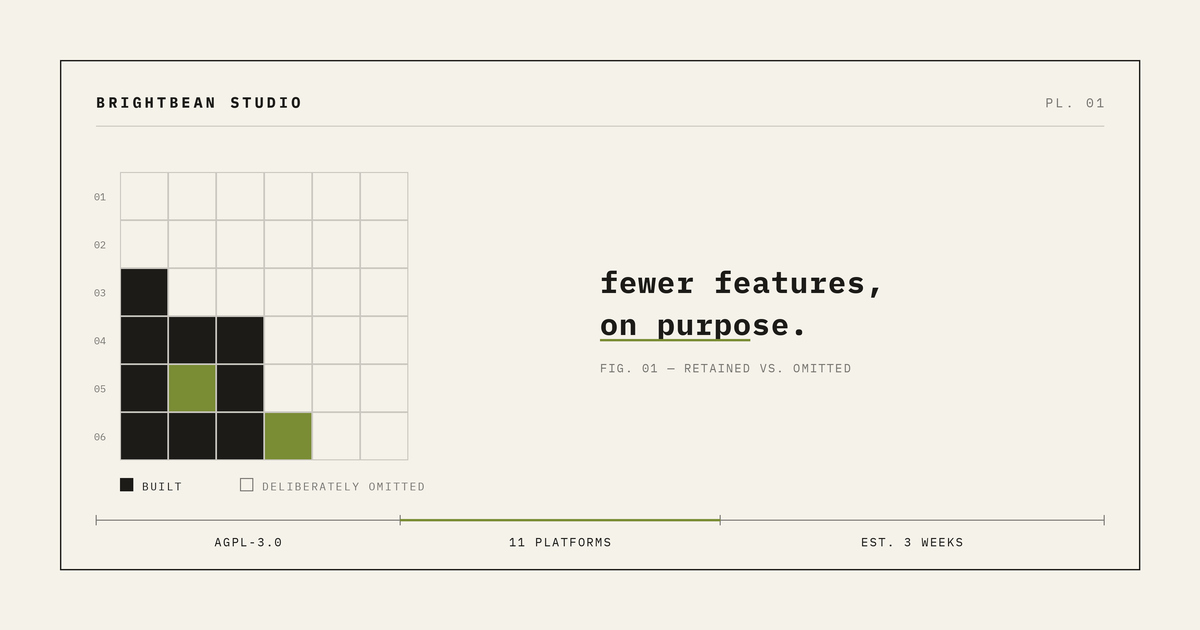
Fewer features than Buffer, on purpose
When I started building BrightBean Studio, my first instinct was the wrong one. I made a list of what Buffer, Sendible, and Hootsuite each do, and I started building toward it. Analytics dashboards. An AI caption generator. A link-in-bio page. A dozen things that look good in a launch video.
Then I deleted half of the list.
Not because a deadline forced me to. Because the list itself was the trap. Every feature on it was a promise I would have to keep for years, on a team of two people. The real question was never “what can we add?” It was “what can we maintain without lying to the people who depend on it?”
Restraint is a maintenance promise
Most tools in this category compete on feature count. The pitch is a longer list than the last tool’s list. That works right up until the team shipping the list is small, and then every feature becomes a quiet liability: a thing that breaks when a platform changes its API, a thing a support email will ask about, a thing that has to survive the next framework upgrade.
A two-person team cannot keep a hundred promises well. It can keep a dozen. So the design rule for Studio is the opposite of the category’s: add a feature only when we are confident we can still be maintaining it in three years. That single rule decided almost everything below.
What Studio actually does
Studio publishes to 11 platforms using a drag-and-drop calendar with named queues. It runs a unified inbox that pulls comments, mentions, and DMs into one place. It supports multiple workspaces with role-based approvals, so you can bring a contractor in for two weeks and remove them without paying for a seat, and a client can review and approve a post through a passwordless magic link without ever creating an account.
That is most of the list. It is the part of social media management that an agency or a small team actually does every day, and it is the part we were sure we could keep working.
What it deliberately does not do
No analytics dashboard yet. The per-platform insights are there, but the big aggregated reporting view is not, because a reporting surface that looks impressive and quietly goes stale is worse than no surface at all.
No AI that writes and posts for you. We use AI to write our own code. We did not sprinkle an “AI caption generator” into the product to justify a tier, because there is no tier to justify.
No link-in-bio page. It is a genuinely useful adjacent product and a different problem from publishing. Bento, Beacons, and Linktree’s free tier already solve it.
No Twitter/X. Their API pricing starts around $100 per month just for posting access. Supporting it would force a number onto a product whose entire promise is that the number stays zero. So we left it out, and we say so instead of burying it.
Each of those omissions is a feature Buffer has and Studio does not. I would rather state the gap than paper over it.
The stack is boring on purpose
Studio is Django, HTMX, Postgres, and Docker. No single-page-app front end, no Redis, no Celery, no managed-service dependencies. A single small server runs dozens of workspaces comfortably.
Boring is the point. Two people can hold the entire system in their heads, which is the only reason the most common question we get has a real answer. People do not ask for new features first. They ask “is this still going to be here next year?” because they have been burned by tools that were not. The boring stack is how “yes” stays true.
How it stays free
Studio is open-source under AGPL-3.0, free on our hosted infrastructure or self-hosted with Docker on a small VPS. The price is zero and the license is the reason it can stay zero: AGPL means nobody, including us, can quietly relicense it into a paid SaaS later.
It stays free because it is not the business. Our paid product is BrightBean Intelligence, a YouTube intelligence API for AI agents. Studio’s job is to be genuinely useful to the kind of people who also turn out to need Intelligence. That is the whole funding model, stated plainly, because a free tool with an unexplained business model is exactly the thing that makes careful people nervous.
Where Buffer wins
This is not a takedown. Buffer has been refining this product since 2010, and it shows. The iOS and Android apps are well built, the Start Page link-in-bio is a useful extra, and the AI caption assistant is further along than anything Studio offers, because Studio offers none. Buffer also ships a documented public API and a browser extension.
If you post to one to three channels, live on your phone, and want a polished native app today, Buffer’s free plan is hard to argue with. The trade only tips toward Studio when you add channels, teams, clients, approvals, or a reason to own your own data. The full head-to-head is in our BrightBean Studio vs Buffer comparison, including the cases where Buffer is the right call.
The trade we wanted
Fewer features. Fewer promises. All of them kept.
That was the trade. It is a worse product on a feature-count spreadsheet and a better one for the small teams that have been left holding the bill when a tool they trusted changed under them. We would rather be the boring, smaller thing that is still here in three years than the impressive one that is not.
If that is the trade you want too, Studio is free and open-source. You can start on the hosted version or read the code and self-host it. Either way, the price next year is the same as the price this year.