
Building in the Open: How Two People Ship, Price, and Market Software
A two-person team built a free open-source scheduler, added up what the incumbents actually charge, and put its own marketing in a git repo. One thesis connects them: trust is the only moat that compounds with the user.
On this page
TL;DR: Over the past month a two-person team shipped a free open-source scheduler with deliberately few features, priced Buffer, Sendible, and Hootsuite against a self-hosted alternative (including where those tools win), and put its own marketing in a git repo that proposes its own improvements while a human approves every post. One thesis connects all three: trust is the only moat that compounds with the user instead of against them. Here is the whole picture, including what we have not earned yet.
Building in the open
BrightBean is two people. That single fact decides more than it sounds like it should. It decides what we can build, what we can promise, and how we are allowed to talk about any of it. When a company is two people, the gap between what you claim and what you can actually deliver closes fast and in public, so the only durable strategy is to not have a gap.
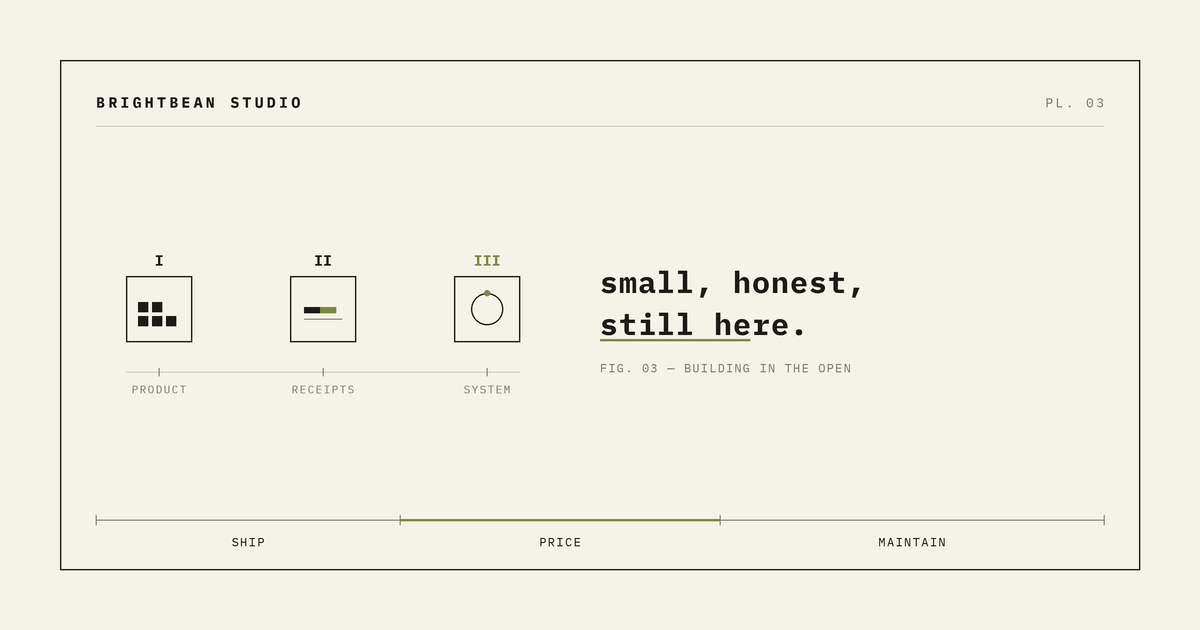
Three things we did this month are really the same move, applied to the product, the pricing, and the marketing.
The product: build less, on purpose
We shipped BrightBean Studio with fewer features than Buffer, deliberately. Eleven platforms, a drag-and-drop calendar, a unified inbox, multi-workspace approvals, on a boring Django and HTMX stack a small team can actually maintain. We left out the analytics dashboard, the AI caption writer, the link-in-bio page, and Twitter/X.
The reasoning is in a separate post, but the short version is that every feature is a promise to maintain it for years. Two people keep that promise by keeping the surface small. Restraint is not a limitation we are apologizing for. It is the design.
The pricing: show the math, including where you lose
Studio is free, AGPL-3.0, hosted or self-hosted on a VPS that runs around five dollars a month. The comparison against the incumbents is not a hit piece. We wrote down where each one genuinely wins: Later is better for a solo Instagram creator, Hootsuite has deeper analytics, Buffer’s mobile app and caption AI are further along than ours.
A comparison that only flatters the thing you are selling is an advertisement. A comparison that tells you when to pick the competitor is information. We would rather publish the second kind, because the people we want as users can tell the difference, and because it is true.
The marketing: a system that cannot lie
Our marketing lives in a git repo. A nightly job grades each post against its own median and writes down what it learns. A weekly job proposes playbook changes when a pattern repeats, and a human merges them. The full architecture is here. The two boundaries that matter: it never publishes on its own, and it is never allowed to edit what the brand believes.
The reason that matters for this post is simple. A marketing system optimizing for engagement, with no human gate and permission to rewrite its own values, eventually learns to exaggerate. Ours physically cannot. That is not a personality trait we are hoping holds up under pressure. It is a constraint in the code.
The moat: trust that compounds with the user
Here is the thread through all three. Most software moats are built against the user. Lock-in, data you cannot export, per-seat pricing that charges you more precisely as you grow, the exact moment scaling should get easier. Those moats work, and they corrode the relationship a little more every quarter.
Trust is the one moat that compounds with the user instead of against them. It grows for one boring reason: you keep promises. The price stays zero. The license stays AGPL. The status stays true. None of those are clever growth tactics. They are just things that remain true, and remaining true is the entire strategy.
Where we actually are, and the ask
So, plainly: Studio is live and free. Intelligence, the YouTube API that funds it, is live with a free tier and no paying customers yet. We are not going to dress that up. What we want next is the first real conversations with people building AI agents that need YouTube data, because that is how we learn what the next endpoints should be.
If you are building in that space, the docs are here. If you just need a scheduler that will not move under you, Studio is free and will stay that way. Either way, you can watch us build the rest of this in the open, which is the only way we know how to do it now.