
MCP Servers Turn Claude Into a Reasoning Engine for Your Data
The Model Context Protocol is transforming Claude from a chatbot into a live reasoning layer over enterprise data. Here's how MCP servers work, why adoption is accelerating, and what the security trade-offs look like in production.
 Jan Schmitz
|
|
10 min read
Jan Schmitz
|
|
10 min read
On this page
TL;DR: Anthropic’s Model Context Protocol (MCP) has gone from open-source experiment to the connective tissue between AI models and enterprise data. With 97 million monthly SDK downloads, backing from every major AI platform, and 28% of Fortune 500 companies running MCP servers in production, the protocol is rewriting how organizations deploy AI. But MCP doesn’t just shuttle data around, it turns Claude (and increasingly, other LLMs) into a reasoning engine that can query, interpret, and act on live business data. That rewrites the playbook for how teams build, secure, and govern AI systems, and the security challenges are just as real as the upside.
MCP Servers Turn Claude Into a Reasoning Engine for Your Data
Eighteen months ago, if you wanted Claude to do something useful with your company’s data, you had two options: paste it into a chat window, or spend weeks building a custom integration. Neither scaled. The first hit context limits. The second created maintenance nightmares every time Anthropic shipped an API update.
The Model Context Protocol changed that equation. And the shift it’s driving cuts deeper than most people realize.
MCP doesn’t just give Claude access to your data. It gives Claude the ability to reason over your data, in real time, across multiple sources, with the kind of contextual awareness that used to require a human analyst parked in front of three monitors and a Bloomberg terminal.
That distinction matters. Access is a solved problem. Reasoning over live, heterogeneous data sources through a single standardized interface? That’s new territory.
The integration problem nobody wanted to talk about
Here’s the dirty secret of enterprise AI adoption in 2024 and early 2025: most deployments were glorified search engines. Companies would dump documents into a vector database, wire up a retrieval-augmented generation (RAG) pipeline, and call it “AI-powered.” The results were impressive in demos and mediocre in production.
The reason wasn’t that the models were bad. They were starved. An LLM reasoning over stale, pre-chunked document fragments is like a financial analyst working with last quarter’s numbers printed on index cards. Technically functional. Practically useless for decisions that matter.
The root issue was the M×N integration problem. If you had M different AI tools and N different data sources, you needed M×N custom connectors. Every new tool meant N new integrations. Every new data source meant M new connectors. The math worked against you fast.
Anthropic saw this clearly when they open-sourced MCP in November 2024. Their framing was deliberate: MCP is “USB-C for AI.” One standardized plug that works everywhere, replacing the drawer full of proprietary cables.
How MCP actually works under the hood
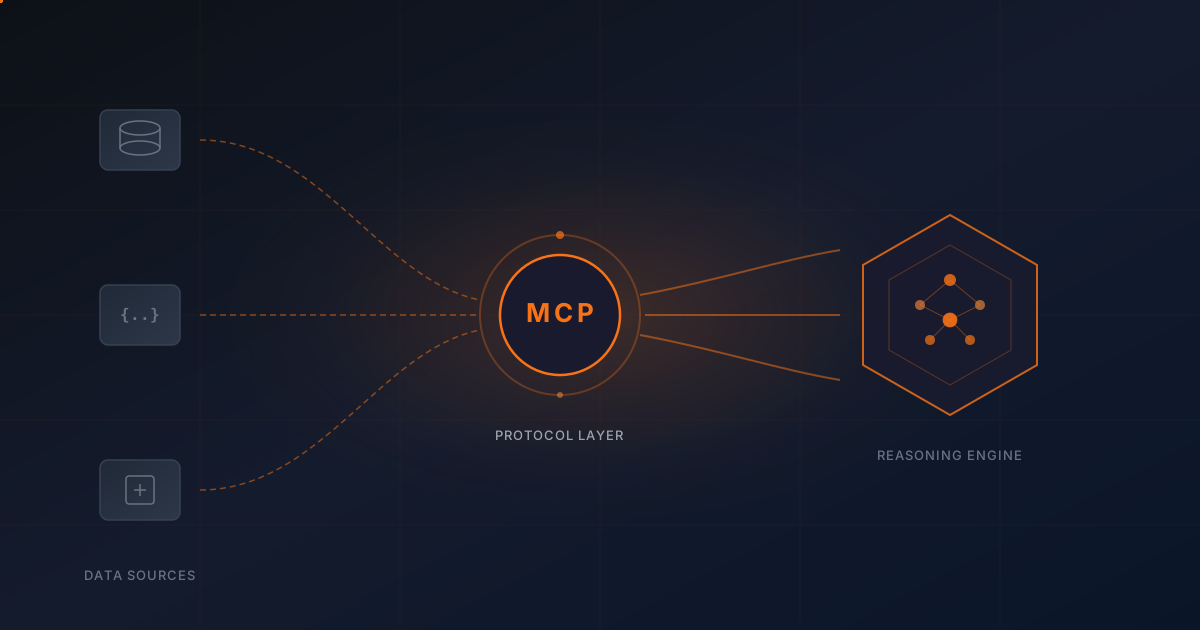
Strip away the marketing and MCP is a client-server protocol built on JSON-RPC 2.0, borrowing heavily from the Language Server Protocol (LSP) that powers code editors like VS Code. It’s not revolutionary computer science. It’s good engineering applied to a genuine problem.
The architecture has three moving parts:
MCP Servers expose data and capabilities through a standardized interface. A server might wrap a PostgreSQL database, a Salesforce instance, a GitHub repository, or a proprietary internal API. The server defines what tools are available (functions the AI can call), what resources exist (data it can read), and what prompts make sense (templates for common interactions).
MCP Clients are the AI applications that connect to servers. Claude Desktop, Claude Code, Cursor, Windsurf, these are all MCP clients. When you connect Claude to an MCP server, Claude can discover what tools and data are available, then fold them into its reasoning process.
The Protocol handles the handshake, capability negotiation, and message passing between client and server. It manages tool discovery, parameter validation, and result formatting so that neither side needs to know implementation details about the other.
What makes this more than a fancy API wrapper is the bidirectional, stateful nature of the connection. Traditional REST APIs are request-response: you ask a question, you get an answer, the connection forgets everything. MCP maintains context across interactions. Claude can fire a series of queries, each building on the results of the last, the same way a human analyst would drill down through data to chase an answer.
Say a product manager asks Claude: “Which enterprise customers are at risk of churning this quarter?” With MCP servers connected to the CRM, support ticket system, and usage analytics platform, Claude doesn’t just look up a churn score in a spreadsheet. It pulls recent support tickets, checks product usage trends, cross-references contract renewal dates, and synthesizes an answer that accounts for all three signals. That’s reasoning. That’s what a dedicated customer success analyst would do, except it takes seconds instead of hours.
The ecosystem nobody expected to grow this fast
When Anthropic dropped MCP in late 2024, the skeptics had a fair point. Open protocols from single vendors tend to die quietly. Remember Google’s gRPC push for universal microservices communication? Or Facebook’s GraphQL as the “REST killer”? Both carved out niches but never hit the universal adoption their creators imagined.
MCP broke that pattern, and the numbers speak for themselves.
SDK downloads went from roughly 100,000 in November 2024 to 97 million monthly by December 2025. The public registry PulseMCP lists over 5,500 servers. Total cataloged MCP servers across all registries top 14,000, with more than 300 clients.
The turning point came in March 2025, when OpenAI, Anthropic’s most direct competitor, integrated MCP support across its Agents SDK and ChatGPT desktop app. Google DeepMind followed a month later with Gemini support. Microsoft Copilot jumped in. Overnight, MCP stopped being “Anthropic’s protocol” and became the industry default.
In December 2025, Anthropic made it official by donating MCP to the Agentic AI Foundation (AAIF), a directed fund under the Linux Foundation co-founded by Anthropic, Block, and OpenAI. That governance move killed the last credible objection from enterprise procurement teams sweating vendor lock-in.
The adoption numbers in regulated industries stand out. According to industry analysis, roughly 28% of Fortune 500 companies have deployed MCP servers in production, up from 12% a year earlier. Fintech leads at 45% adoption. Healthcare sits at 32%. E-commerce at 27%.
Why “reasoning engine” isn’t just marketing speak
There’s a useful line between AI as a retrieval tool and AI as a reasoning tool, and MCP is what makes the second category work at scale.
Retrieval is straightforward: “Find me the Q3 revenue number.” Any well-indexed search system handles that. Reasoning is harder: “Given our Q3 revenue trend, current pipeline, and the three deals we lost last month, should we revise our Q4 forecast?” That requires pulling data from multiple sources, understanding how the data points relate to each other, applying domain knowledge, and forming a judgment.
Before MCP, getting Claude to reason across multiple live data sources meant stitching together API calls in application code, formatting the results, stuffing them into a prompt, and hoping the context window was big enough to hold everything. Developers became plumbers, spending more time on data wiring than on the actual AI logic.
MCP flips that. The developer’s job shifts from “build pipes between systems” to “define what data and actions should be available.” Claude handles the orchestration, deciding which tools to call, in what order, and how to combine the results.
This is what Anthropic means when they position Claude as a reasoning engine. The model isn’t just pattern-matching against text in a prompt. It’s deciding what data to request, judging whether the results are sufficient, and iterating until it has enough context to give a useful response. That’s a fundamentally different interaction model from the chatbot paradigm most people still picture.
Building an MCP server: simpler than you’d think
One reason MCP adoption took off so quickly is the low barrier to entry. The Python and TypeScript SDKs on GitHub make standing up a basic server pretty painless.
A minimal MCP server needs three things:
-
Tool definitions, functions the AI can invoke, with typed parameters and descriptions. Think of these as the “verbs” the AI understands:
query_customers,get_support_tickets,run_sql_query. -
Resource declarations, data the AI can read or browse. These are the “nouns”: customer lists, product catalogs, configuration files.
-
Transport configuration, how the client and server communicate. Local servers use stdio (standard input/output). Remote servers use HTTP with Server-Sent Events for streaming.
A developer who knows their data stack can have a working MCP server running in an afternoon. The pre-built servers for PostgreSQL, GitHub, Slack, Google Drive, and Puppeteer cover the most common use cases out of the box.
The hard part isn’t building the server. It’s building a production-grade server. And that’s where things get uncomfortable.
The security problem that won’t go away
Every conversation about MCP in enterprise settings eventually lands on security, and for good reason. The protocol’s rapid adoption has outrun its security maturity, and the gaps are real.
A 2025 security analysis of MCP server implementations found that while 88% of servers require some form of credentials, over half (53%) rely on static API keys or personal access tokens. These are long-lived secrets that rarely get rotated. Worse, 79% of those keys are passed through environment variables, a pattern that works on a developer’s laptop but creates serious exposure risk in production.
The OWASP foundation has drafted an MCP Top 10 risk list, and “Insufficient Authentication and Authorization” sits near the top. The other major threat vectors:
Prompt injection through tool descriptions. An attacker who controls an MCP server (or compromises one) can embed hidden instructions in tool descriptions that steer the AI’s behavior. The AI reads these descriptions to understand what each tool does, and trusts them implicitly.
Token storage vulnerabilities. MCP servers that connect to multiple downstream services accumulate credentials. A compromised server becomes a skeleton key to every system it touches.
Toxic agent flows. When an AI chains together multiple tools across multiple MCP servers, the combined action can exceed what any individual tool’s security controls anticipated. Data pulled from one source gets passed to another tool that writes to a third system, and nobody designed the end-to-end flow with security in mind.
Plaintext credential exposure. Local configuration files storing MCP server tokens are sitting targets on developer machines and CI/CD systems.
Qualys recently flagged MCP servers as “the new shadow IT” for AI in 2026, individual developers and teams spinning up servers without IT oversight, connecting them to production data, and creating blind spots that existing monitoring tools can’t see.
The 2026 MCP roadmap acknowledges these gaps head-on. Enterprise readiness is the stated top priority, with work focused on standardized authentication, audit trails, gateway patterns, and configuration portability. But closing these gaps takes time, and organizations are deploying MCP in production right now.
What enterprise teams are actually doing
The organizations running MCP successfully in production share a handful of patterns.
They’re wrapping, not exposing. Smart teams don’t point MCP servers directly at raw databases. They build a controlled layer that enforces business logic, access controls, and data transformations. The MCP server exposes a curated set of capabilities, not a blank check on the data layer.
They’re investing in observability. The MCP observability specification is still maturing, so most teams bolt on their own logging and monitoring. Every tool call, every data request, every response gets logged with enough context to reconstruct what the AI did and why.
They’re enforcing least-privilege access. Each MCP server connection gets scoped tokens tied to the authenticated user’s permissions. If the user can’t see certain data in the source system, the AI can’t see it through MCP either. Sounds obvious, but it requires deliberate implementation, the protocol doesn’t enforce it automatically.
They’re treating MCP servers like production services. Version control, CI/CD pipelines, staging environments, health checks, rate limiting. The teams that treat MCP servers as throwaway scripts are the ones that end up in incident postmortems.
72% of current MCP adopters expect to increase their usage over the coming year. That confidence tracks with the protocol’s maturation, but it also means the attack surface is expanding in lockstep.
Where this is heading
Four trends are shaping MCP’s trajectory through 2026 and into next year.
Multi-agent orchestration goes mainstream. MCP’s original design assumed a single AI model talking to multiple servers. The next wave is multiple agents collaborating through shared MCP infrastructure, one agent handling financial analysis, another doing legal review, a third working customer data, all coordinated through a common protocol layer. Google’s A2A (Agent-to-Agent) protocol and MCP are already converging on interoperability patterns.
API gateway vendors ship native MCP support. Industry analysts predict 75% of API gateway vendors will add MCP features by late 2026. That means enterprises won’t need to build MCP infrastructure from scratch, their existing API management layer will handle it.
Security governance stops being optional. The “move fast and figure out security later” phase is winding down. Expect MCP security scanning tools, compliance frameworks, and audit requirements from regulators keeping tabs on the agentic AI space.
Human oversight narrows to exception handling. As MCP-powered AI systems prove reliable for routine data tasks, the human role shifts from reviewing every output to handling edge cases and anomalies. That changes staffing models, not just technology stacks.
The bottom line
MCP is doing for AI data access what containerization did for application deployment, taking a messy, fragmented, vendor-specific world and imposing just enough standardization to make the whole ecosystem more productive. The protocol isn’t perfect. The security story has genuine holes. The governance tooling is still green.
But the direction is unmistakable. When OpenAI, Google, and Microsoft all rally behind a protocol that Anthropic created and then handed to a neutral foundation, that’s not a trend. That’s an inflection point.
For teams weighing MCP today, the practical advice is blunt: start with a single, well-scoped use case. Pick a data source your team already understands inside and out. Build the server with production security from day one, not as a follow-up ticket. Log everything. And don’t let individual developers wire MCP servers to production data without IT in the loop.
The organizations that nail MCP governance early will have a real edge. The ones that treat it as another developer toy will learn the hard way that “reasoning engine connected to live enterprise data” and “ungoverned” are two phrases that should never share a sentence.